A new video by Cuéntame and the Washington Office on Latin America, part of a campaign to stop gun smuggling into Mexico, shows the lines of accountability in the gun trade. According to official data, “Over the last 5 years, nearly 60,000 people have lost their lives in Mexico’s drug-related wave of violence. More than 70% of the weapons seized in Mexico in the last three years and submitted for tracing came from the U.S.”
Australian Tobacco Companies Lose Fight Over Packaging
Earlier this month, the High Court in Australia upheld that Government’s pioneering laws to force tobacco companies to put their products in plain packaging. Read an interview with various Australians involved in the tobacco controversy for varying opinions on the national and global significance of the decision.
New study shows alcohol advertisers use magazines to target youth


David Jernigan is an Associate Professor and the Director of the Center on Alcohol Marketing to Youth at the Bloomberg School of Public Health at Johns Hopkins University. He has spent many years studying alcohol advertising to youth. In a new article published in The Journal of Adolescent Health, Elizabeth Rhoades, also at Johns Hopkins, and Jernigan reported on their study on alcohol advertising in magazines. Corporations and Health Watch’s Nicholas Freudenberg asked Jernigan some questions about the new study. In addition, David Jernigan’s recent column on state laws to control alcohol marketing to youth “Under the Influence” was recently posted Huff Post Science. To read it, click here.
CHW: How did you do this study?
DJ: We examined 1,261 ads for alcopops, beer, spirits or wine that appeared more than 2,500 times in 11 magazines that are popular among teens. These magazines have youth readerships equaling or exceeding 15 percent. The ads were rated according to a number of factors, such as whether they portrayed over-consumption of alcohol, addiction content, sex-related content, or injury content.
CHW: How common were ads with sexual themes?
DJ: Almost one-fifth of the ads contained sexual connotations or sexual objectification.
CHW: What kinds of alcoholic beverages were being advertised in the magazines you studied?
DJ: We found that in our sample, ads were concentrated across type of alcohol, brand and outlet, with spirits representing about two-thirds of the sample, followed by ads for beer, which comprised almost another 30 percent. The ten most advertised brands, a list comprised solely of spirits and beer brands, accounted for 30 percent of the sample, and seven brands were responsible for more than half of the violations of industry marketing guidelines.
CHW: And what were your conclusions?
DJ: The content of alcohol ads placed in magazines is more likely to be in violation of industry guidelines if the ad appears in a magazine with sizeable youth readership. We also found that the prevalence of problematic content in magazine alcohol advertisements is concentrated in advertising for beer and spirits brands. Violations of industry guidelines and addiction content appear to increase with the size of youth readerships, suggesting that individuals aged 21 and under may be more likely to see such problematic content than adults.

CHW: What does your study say about the alcohol industry’s voluntary codes?
DJ: The finding that violations of the alcohol industry’s advertising standards were most common in magazines with the most youthful audiences tells us self-regulated voluntary codes are failing. It’s time to seriously consider stronger limits on youth exposure to alcohol advertising.
CHW: So what’s the bottom line meaning of your study?
DJ: Alcohol is responsible for 4,700 deaths per year among young people under the age of 21, and is associated with the three leading causes of death among youth: motor vehicle crashes, homicide and suicide. Youth are getting hit repeatedly by ads for spirits and beer in magazines geared towards their age demographic. At least 14 studies have found that the more young people are exposed to alcohol advertising and marketing, the more likely they are to drink, or if already drinking, to drink more. This report should serve as a wake-up call to parents and everyone else concerned about the health of young people.
CHW: What’s the mission of your Center?
DJ: The Center on Alcohol Marketing and Youth (CAMY) monitors the marketing practices of the alcohol industry to focus attention and action on industry practices that jeopardize the health and safety of America’s youth. Reducing high rates of underage alcohol consumption and the suffering caused by alcohol-related injuries and deaths among young people requires using the public health strategies of limiting the access to and the appeal of alcohol to underage persons.
Photos courtesy of Center on Alcohol Marketing to Youth
Big Tobacco Shills Trying to Stop GMO Labeling in California
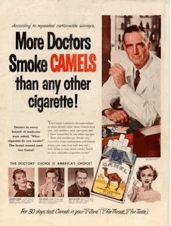
 Cross-posted from Appetite for Profit
The food industry really hates it when you compare them to Big Tobacco. They try to deny the negative association by claiming that food is different than tobacco. Of course that’s true, but why are the same consultants that have worked for the tobacco industry now shilling for Big Food, opposing the ballot initiative that would require labeling of all foods containing GMO ingredients?
Hiring Secret Consultants for the Dirty Work
The latest financial filings in California for the “No on 37: Coalition Against the Deceptive Food Labeling Scheme” – reveal a $7,500 payment to the Sacramento-based political consulting firm, MB Public Affairs. Here is how the Los Angeles Times described the firm last year:
MB Public Affairs is headed by Mark Bogetich, a garrulous operative known to his friends as “Bogey,” who has helped a number of Republican candidates neutralize their opponents. In recent years, MB Public Affairs has worked for Altria, once known as the Phillip Morris Cos. …
Bogetich has also been called “the go-to guy for [the Republican] party,” and “the only game in town.” The L.A. Times article explains how last year MB Public Affairs filed more than 50 public record act requests to dig up dirt on a small but effective group called the Los Angeles Alliance for a New Economy. No wonder, since the organization has scored such important victories as a living wage for workers, which would threaten plenty of businesses.
But which ones? Who knows, because by hiring MB Public Affairs to do its dirty work, industry gets to keep its nose clean – a classic Big Tobacco tactic. Well-known brands such as PepsiCo (which I wrote about last week) and Kraft don’t want to be associated with negative campaigning, so they farm out the job to consulting firms. In this case, they went right to the top, or the bottom. Things are likely to get ugly.
Creating Front Groups for the Dirty Work
Another tactic honed by Big Tobacco is to form a front group, which appears to be made up of small businesses and others designed to give the impression of a grassroots campaign, but in reality is funded by large corporations. This tactic, known as an Astroturfing, is alive and well with “No on 37,” which describes itself as, “A broad coalition of family farmers, scientists, doctors, taxpayers, small businesses, labor, food companies, biotechnology companies and grocers.
Small farmers and small businesses? I don’t see any listed on the “Who We Are” page. I do see many not-so-small trade groups representing numerous not-so-small corporations, some of them from outside California, including CropLife America, which is a trade group for the biotech and pesticide industry.
Also, the “No on 37” campaign is represented by the law firm, Bell, McAndrews & Hiltachk, which has a sordid history of stealth tactics such as Astroturfing. And no wonder, with former Phillip Morris outside council Tom Hiltachk as the campaign’s treasurer. (His firm’s address is listed on the webpage for where to send donations; can’t get much cozier with the No campaign than that.)
Hiltachk had this disingenuous quote about the GMO labeling initiative back in February: “Farmers and food producers strongly oppose this costly, ill-conceived labeling proposition.” There are those invisible farmers again.
No stranger to California politics, Hiltachk’s firm represents the California Republican Party and helped make Arnold Schwarzenegger governor by orchestrating the statewide recall campaign of former Governor Gray Davis.
According to PolluterWatch, Tom Hiltachk and his firm are well known for creating front groups that promote or attack ballot initiatives at the behest of the firm’s wealthy corporate clients: “In the past Hiltachk has attacked anti-smoking initiatives while being paid by major tobacco corporations.”
And this scathing article at ThinkProgress from 2010 describes Hiltachk’s attempt to repeal California’s clean energy policy and says his “under-the-radar tactics of shifting money around and using phony groups are nothing new.” Specifically:
During the eighties and nineties, Hiltachk and his law partners helped the tobacco industry, with funding from Philip Morris and R.J. Reynolds, coordinate a variety of stealth front groups. While his law firm received over a million from tobacco interests, Hiltachk helped organize “Californians for Smokers’ Rights,” a supposedly “grassroots” group that relied on tobacco industry consumer lists to mobilize opposition to anti-smoking initiatives.
Another Big Tobacco front group Hiltachk’s firm managed was “Californians for Fair Business Policy,” which fought local efforts to enact smoke-free bans in California in the early 1990s.
This is going to be a busy election season for Hiltachk, as he is also the mastermind behind the deceptive union-busting Proposition 32, about which a local California paper writes: “if you liked Citizens United, you will love Prop 32.” As the New Yorker sums it up in an article describing the firm’s shady operations, “They specialize in initiatives that are the opposite of what they sound like.”
Another group with Big Tobacco origins now spreading lies about the GMO labeling initiative is the unsubtle front group, “California Citizens Against Lawsuit Abuse,” whose executive director recently warned us to “beware of trial lawyers lurking in your food.” (It seems lawyers are scarier than altering the genetic code of the food supply.) According to the Center for Media and Democracy’s Sourcewatch, Philip Morris is a primary funder of various “Citizens Against Lawsuit Abuse” groups, which under the guise of tort reform aim to make it harder to bring lawsuits for problems caused by hazardous products.
Doubt is Their Product
In sum, the food industry, to oppose a simple labeling law, is hiring lawyers and consultants with ties to the tobacco industry, to deploy stealth tactics such as creating front groups, digging up dirt on opponents, and spreading outright lies.
For decades the tobacco industry and its shills hid the truth by deploying its most effective weapon: manufacturing doubt about the health hazards of smoking. How many millions of Americans died as a result of Big Tobacco’s deceptive and cynical campaign? Why would we trust these same operators now?
You can hardly blame industry for calling on such shady characters. Big Food has seen the polling data showing that more than 90 percent of consumers want to see GMO foods labeled. When you don’t have the people or the truth on your side, all you have left is playing dirty.
Antipsychotic Drug Prescriptions for Off-label Conditions Increase for Children and Youth
In an article published this month in the Archives of General Psychiatry, Mark Olfson and his colleagues reported that between 1993-1998 and 2005-2009, visits with a prescription of antipsychotic medications per 100 persons increased almost eightfold for children, almost five fold for adolescents, and almost doubled for adults. Only a small proportion of child and adolescent antipsychotic visits included an FDA clinical indication; many prescriptions were for off-label use. An earlier commentary by the psychiatrist Dr. Peter Breggin on the Huffington Post links this increased use to unethical drug company marketing practices.
McDonald’s to customers: Eat more
McDonald’s new Breakfast After Midnight menu — available in locations across the state of Ohio and in Denver and Boston — offers limited breakfast offerings from 12 a.m. onward. Included are popular items like Egg McMuffins, Sausage McMuffins, hotcakes with sausage, breakfast burritos, fruit and maple oatmeal, hash browns, juice and coffee. The Huffington Post reports that the menu will be available in all 24-hour McDonald’s stores in featured markets. One slogan for the campaign is “the moon is full you should be too.”
Wall Street Journal editorials recycle anti-regulatory arguments
To forestall policy on climate change, the Wall Street Journal editorial board routinely downplays scientific consensus, overstates the cost of taking action, and claims that politics, not science, motivates those concerned about the climate. But in a new analysis of more than 100 editorials from 1976 to present, Media Matters for America shows that the Wall Street Journal used these same rhetorical tactics in previous decades on acid rain and ozone depletion and these arguments did not stand the test of time.
Air pollution to increase by 2050
According to a new report from scientists at the Max Planck Institute for Chemistry, the Institute of Atmospheric Physics and the Joint Research Centre of the European Commission, in 2050, the air quality worldwide will be as bad as it already is nowadays in urban areas of Southeast Asia, one of the most polluted places on Earth. Air pollution in Europe and North America would also increase, but due to the effect of mitigation policies – that have been in place for more than two decades now – to a much lesser extent than in Asia. Urban air pollution is estimated to kill 1.2 million people each year and the largest single source is motor vehicle exhaust.
More on New York City Soda Limits Proposal

Cross-posted from the Center for Food Safety

Last week I had the pleasure of lending my support, on behalf of the Center for Food Safety, to New York City’s proposal to limit the size of sugary beverages sold at food service outlets. (I wrote previously about why this policy makes sense.) The hearing room at New York’s health department was packed with media outlets and hundreds of folks eager to witness the showdown with Big Soda.
Interestingly, no one from an actual soda company spoke up. But we did hear from several trade associations, along with members of the city council, several of whom objected to the idea over potential negative impacts on small business. As I explained in my own remarks, this talking point is a classic misdirect put up by major corporations. Here are a few excerpts from my comments:
This isn’t about choice or any other distracting rhetoric.
The soda industry, because it does not have science (or even common sense) on its side, is resorting to methods of distraction such as claiming that this proposal is an affront to consumer choice. Of course, this proposal doesn’t take anybody’s choice away. New Yorkers who wish to consume more than 16 ounces are free to purchase more.
But let’s take a closer look at the concept of choice. It is the soda industry that has taken away the choice of reasonable portion sizes. Nobody demanded larger beverages. Cups got larger and larger over the years because the soda industry (in coordination with food service outlets) realized it has a gold mine on its hand. When the beverage industry and its cohorts use the word “choice,” it’s really code for threatened profit margins — which are estimated to be as high as 90 percent. 90 percent.
The soda industry is acting like Big Tobacco.
One tried and true tactic of the tobacco industry is inventing “grassroots” smokers’ organizations, a strategy known as Astro-turfing (as in fake grass). It’s a great way for companies that don’t want their fingerprints on a controversial campaign to hide behind a front group. Such groups tend to garner public sympathy and support while attracting media attention.

“New Yorkers for Beverage Choices” is a classic Astro-turfing campaign led by the American Beverage Association, the soft drink industry’s lobbying group, which has retained powerful political and PR consultants. Who made this list of alleged New Yorkers so concerned with their choices? For starters, other lobbying groups outside of New York, such as:
- The Grocery Manufacturers Association
- The International Franchise Association
- The National Association of Concessionaires
- The National Association of Theater Owners
- The National Restaurant Association
Also, restaurant chains like Chick-Fil-A, Denny’s, and Darden Restaurants, owner of Olive Garden and Red Lobster, among others. Not quite the sort of grassroots activism members you hope for in a campaign about personal choice.
Additional Big Tobacco-style tactics from the soda lobby include:
- Shooting the messenger and name-calling, by depicting Mayor Bloomberg as a “nanny” in full-page ads taken out by the industry front group, Center for Consumer Freedom, which not coincidentally, began with funding from Philip Morris and is run by notorious tobacco lobbyist Rick Berman;
- Claiming to take the side of small businesses because they know the public and the press have more sympathy for the little guy than multinational corporations such as Coca-Cola and PepsiCo;
- Claiming to care about the economic plight of poor people, never mind the fact that the soda industry targets these same populations with advertising designed to get them hooked for life on their unhealthy products.
Ultimately, the tobacco industry lost all credibility with the American public (along with most policymakers) by engaging in such deceitful tactics.
In conclusion, the soda industry is running scared because they know the jig is up; that the public health crisis their products have helped create means that industry cannot keep enjoying the same unfettered regulatory environment. This common sense proposal will catch on as other cities take New York’s lead. This is an idea whose time has come.
You can read the submitted comments here. A decision by New York’s Board of Health is expected in September.
UN Fails to Agree to Arms Trade Treaty
One person every minute dies from armed violence around the world, and arms control activists say a convention is needed to prevent illicitly traded guns from pouring into conflict zones and fueling wars, criminal violence and atrocities. Last week, however, delegates from 170 nations who had spent the last month negotiating a treaty, announced their failure to reach agreement, at least for now. Ultimately, reports Reuters, arms-control activists blamed the United States and Russia, two of the world’s largest arms exporters, for the inability to reach a decision, as both countries said there was not enough time left for them to clarify and resolve issues they had with the draft treaty.
 Corporations and Health Watch