Civil society groups call on WTO to extend patent rules for least developed countries

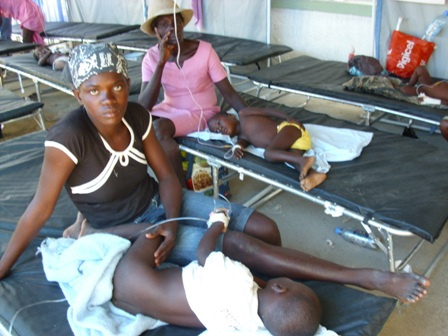
A health care facility in Haiti, the nation initiating request for extension                                                                           Credit
A health care facility in Haiti, the nation initiating request for extension. Credit

On February 21, 2013, 376 civil society organizations sent a letter to members of the World Trade Organization (WTO) calling for a further extension of the transition period for Least Developed Countries (LDCs) under article 66.1 of the TRIPS (Trade Related Aspects of  Intellectual Property Rights) Agreement. (For more on TRIPS).  Excerpts are below:


Dear Members of the World Trade Organization (WTO),


As civil society organizations concerned with access to medicines, to educational resources, to environmentally sound technologies (ESTs), and to other public goods and cultural creations and further concerned with farmers’ rights, food security, human flourishing, sustainable and equitable technological and industrial development in Least Developed Countries (LDCs), we call on WTO Members to unconditionally accord the LDC Group an extension of the transition period as requested by the LDC Group in their duly motivated request to the TRIPs Council (IP/C/W/583).


Article 66.1 of the TRIPS Agreement accorded LDC Members of the WTO a renewable ten-year exemption from most obligations under the TRIPS Agreement in view of the special needs and requirements of the LDC Members, their economic, financial and administrative constraints and their need for flexibility to create a viable technological base.


This exemption was originally due to expire on 31 December 2005. However, a TRIPS Council decision of 27 June 2002, exempted LDCs from having to implement or enforce patents and test data obligations with regard to pharmaceutical products until 1 January 2016. Without prejudice to this extension, the TRIPS Council extended the general TRIPS compliance transition period for LDC Members for all obligations under the TRIPS Agreement, other than Articles 3, 4 and 5, until 1 July 2013 or until such date on which a Member ceases to be an LDC, whichever date is earlier.


On 5 November 2012 the Delegation of Haiti on behalf of the LDC Group submitted a duly motivated request to the WTO TRIPS Council for an extension of the LDC transition period, until a Member ceases to be a LDC. Annexed to the request is a draft decision text for the consideration of the TRIPS Council. The draft decision states: “Least developed country Members shall not be required to apply the provisions of the Agreement, other than Articles 3, 4 and 5, until they cease to be a least developed country Member”.


We are of the view that Article 66.1 obliges the TRIPS Council to approve without conditions the duly motivated request submitted by the LDCs. Thus we strongly urge all WTO Members to urgently support the LDC Group request and to approve the LDC request and proposed draft decision.


LDCs are fully justified in seeking an unlimited extension for so long as any LDC Member is so classified because shorter extensions, even sequential extensions, will not give LDCs adequate time to overcome capacity constraints and to develop a viable and competitive technological base. By definition, LDCs face ongoing resource and human constraints, widening technological gaps, and weak innovative capacities. Overcoming these problems takes contextually specific strategies, policy flexibility, greater financial resources, but it also takes time – decades not years. Similarly, LDCs are fully justified in seeking a group extension rather than individual country extensions and in seeking extensions with respect to all TRIPS obligations rather than select obligations only. LDCs, by definition, are similarly situated with respect to development challenges and they should have full flexibility as a group. LDCs are also fully justified in not promising to maintain current levels of IP protections. LDCs must not be asked to undertake additional obligations.


In conclusion we request that:

  • All WTO Members honor their obligation under Article 66.1 and unconditionally accord to the Least Developed Countries the requested extension. Accordingly all WTO Members should support and agree at the upcoming meetings of the TRIPS Council to the draft decision text presented by the LDC Group that: “Least developed country Members shall not be required to apply the provisions of the Agreement, other than Articles 3, 4 and 5, until they cease to be a least developed country Member”.
  • WTO Members do NOT attach to the extension decision any conditions and limitations that limit the policy space and flexibility available to LDCs under Article 66.1 of TRIPS.


In conclusion, we stress that any attempt to weaken or to refuse Least Developed Countries (LDCs) rights that they are entitled to under the TRIPS Agreement will damage the credibility of the WTO as it will show that the multilateral trading system is unable to benefit the poorest and most vulnerable segment of the international community.


The full text of the letter and a list of the 376 signing organizations is available here.

From activist to EPA: Tejada ready to “speak truth” about environmental justice

Environmental Health News reports that the US EPA is turning to a Houston activist Matthew Tejada, for the past five years the director of Air Alliance Houston, to lead its Office of Environmental Justice. Tejada will bring to the job what he’s learned battling severe pollution problems in Houston’s low-income communities where air pollutants spewed by oil refineries, chemical plants and the shipping industry are linked to cancer and asthma. “Not only do I feel like I have the guts to speak truth, as many environmental justice leaders demand,” Tejada told the EHN, “but I feel like I can do it in a way where people will listen.”

Fighting the other NRA (National Restaurant Association) – Resources to support workers

Cross-posted from Appetite for Profit

2.20CHW


This week I’ve been writing about the National Restaurant Association (the other NRA) and why we should care about food workers, in part to bring attention to the new book Behind the Kitchen Door by labor advocate Saru Jayaraman. Today I want to offer practical resources for how to help improve the lives of the 20 million food workers who help us put food on our own tables every day.


Get Informed


In addition to buying the book, Behind the Kitchen Door, the following books and reports will help arm you with the information you need.


  • American Way Eating: This book by Tracie McMillan opened my eyes to the plight of workers in the three settings where she went undercover for a first-hand experience: the farm fields of California, a Walmart in Michigan, and an Applebee’s in New York City.
  • Fast Food Nation: This 2001 best-selling book by Eric Schlosser still resonates today, especially the description of the horrific dangers workers face in meat slaughterhouses, as well the exploitation of fast food workers.
  • Hands that Feed Us: This report by the Food Chain Workers Alliance is the best overview I’ve seen on workers in every sector of the food industry: 1) production – farmworkers; 2) processing – slaughterhouse and other facilities; 3) distribution – warehouse workers; 4) retail – grocery workers; and 5) service – restaurant and other settings.
  • Serving While Sick: This report from the Restaurant Opportunities Center based on national surveys revealed that 63% of workers reported cooking or serving while sick and that most faced high rates of exposure to dangerous working conditions.
  • Dime a Day: This report from the Food Labor Research Center at University of California, Berkeley (which Jayaraman directs) explains how a reasonable increase in the minimum wage would have a minimal impact on food prices. As I have explained, scaremongering about higher food prices is a favorite talking point of the National Restaurant Association, regardless of the facts not supporting lobbyist claims.
  • Tipped Over the Edge: This report from the Restaurant Opportunities Center documents disturbing gender inequalities in the restaurant industry. (71% of servers are female.) Women are kept in lower paying jobs and suffer from sexual harassment, among other mistreatment.
  • The Color of Food: This report from the Applied Research Center examines the gender and racial divides across various food sectors, revealing a disturbing pattern of discrimination that keeps women and workers of color at the bottom of the food chain.
  • Good Food and Good Jobs for All: Building upon the Color of Food, this report connects the dots between the good food movement and the dire need for labor reforms, recommending that we combine efforts.


Get Active


In addition to supporting campaigns to raise the minimum wage, both federally and in cities and states across the nation (sign this petition), please support the following organizations and campaigns:

  • Coalition for Immokalee Workers: CIW’s hard work on behalf of farmworkers in Florida has resulted in numerous victories against such corporate behemoths as Taco Bell, McDonald’s, and Burger King. Check out their Fair Food Standards Council, which monitors conditions for tomato growers, their Anti-Slavery Campaign, which helps investigate the worst labor abuses, resulting in criminal charges, and join their March for Rights, Respect and Fair Food from March 3-17.
  • Fast Food Forward: A movement of New York City fast food workers to raise the minimum wage, which is a paltry $7.25 an hour thanks to the powerful restaurant lobby there.
  • Food Chain Workers Alliance: this amazing coalition of organizations brings together those who “plant, harvest, process, pack, transport, prepare, serve, and sell food, organizing to improve wages and working conditions for all workers along the food chain.”
  • Restaurant Opportunities Center United: The group co-founded by Saru Jayaraman that works to improve the lives of 10 million restaurant workers. They have numerous locations in cities around the nation, as well as targeted corporate campaigns, such as Dignity at Darden. You can also download their handy Diner’s Guide (and app of course), which ranks the most popular restaurant chains on worker treatment.
  • Unite Here Food Service: As anyone working on school food knows, food service workers are among the least respected professionals. Unite Here represents food service workers across the U.S. and Canada, in colleges, K-12 schools, corporate cafeterias, airports, stadiums and event centers.
  • United Food and Commercial Workers Union: UFCW advocates for better conditions for 1.3 million workers in the U.S. and Canada, in grocery and retail stores and in the food processing and meat packing industries. Their largest locals include UFCW Local 1500 in New York City and UFCW Local 770 in Southern California.
  • Warehouse Workers United: Among the least visible workers are those (mostly immigrants) moving tons of goods through the nation’s busiest ports often under deplorable conditions, en route to huge retailers such as Walmart. In 2011, I spoke on a panel with a warehouse worker who told his harrowing tale of abuse through a translator. He said the workers were treated like cattle. It was a humbling experience.


Finally here are a few tips about dining out that Saru Jayaraman suggests in Behind the Kitchen Door: 1) Talk to the workers to find out how they are treated; 2) ask restaurant managers about their promotion policies; and 3) adopt a definition of “sustainable food” that includes labor practices. As Jayaraman puts it so bluntly: it’s not enough to obsess over corn syrup or farm-raised salmon: “we absolutely must care about the health and sustainability of the workforce preparing, cooking, and serving our meals.”


Read Michele Simon’s other recent posts on food workers


Top 10 Reasons to Care About Food Workers

How the Other NRA is Making Us Sick

Why the Other NRA Loves the First Lady

The Other NRA: National Restaurant Association

Profits and pandemics: prevention of harmful effects of tobacco, alcohol, and ultra-processed food and drink industries

The 2011 UN high-level meeting on non-communicable diseases (NCDs) called for multisectoral action including with the private sector and industry. However, through the sale and promotion of tobacco, alcohol, and ultra-processed food and drink (unhealthy commodities), transnational corporations are major drivers of global epidemics of NCDs. In a new article in Lancet, investigators from the The Lancet NCD Action Group examine what role these industries have in NCD prevention and control. They emphasize the rise in sales of these unhealthy commodities in low-income and middle-income countries, and consider the common strategies that the transnational corporations use to undermine NCD prevention and control.

Tea party has ties to tobacco industry

Rather than being a purely grassroots movement that arose spontaneously in 2009, the Tea Party developed in part as a result of tobacco industry efforts to oppose smoking restrictions and tobacco taxes beginning in the 1980s, according to a study by researchers at UC San Francisco recently published online by Tobacco Control.  “Nonprofit organizations associated with the Tea Party movement have longstanding ties to tobacco companies, and continue to advocate on behalf of the tobacco industry’s anti-tax, anti-regulation agenda,” said Stanton A. Glantz, director of the UCSF Center for Tobacco Control Research and Education (CTCRE) and a UCSF professor of medicine and American Legacy Foundation Distinguished Professor in Tobacco Control.

Public health response to global alcohol producers’ attempts to implement WHO global strategy on alcohol

Global Alcohol Policy Alliance                              

glasgow
An alcohol billboard for an expensive brand of champagne is a poor neighborhood in Glasgow, Scotland, with an unemployment rate of 57%. Credit

 On October 8, 2012, thirteen of world’s largest alcohol producers issued a set of commitments to reduce the harmful use of alcohol worldwide, ostensibly in support of the World Health Organization’s (WHO) 2010 Global Strategy to Reduce the Harmful Use of Alcohol.  As an independent coalition of public health professionals, health scientists and NGO representatives, we are submitting this public Statement of Concern to the WHO Secretariat in response to the activities of the global alcohol producers.  Based on their lack of support for effective alcohol policies, misinterpretation of the Global Strategy’s provisions, and their lobbying against effective public health measures, we believe that the alcohol industry’s inappropriate commitments must be met with a united response from global health community.


Our reservations can be summarized as follows:

  1. The commitments are based on questionable assumptions, as stated in the signatories’ Preamble.
  2. The actions proposed in the five commitments are weak, rarely evidence-based and are unlikely to reduce harmful alcohol use.
  3. Prior initiatives advanced by the alcohol industry as contributions to the WHO Global Strategy have major limitations from a public health perspective.
  4. The signatories are misrepresenting their roles with respect to the implementation of the WHO Global Strategy.

This Statement calls upon WHO and its Regional Offices to: clarify the roles and responsibilities of  “economic operators” in the implementation of the WHO Global Strategy; implement stronger conflict of interest policies and continue to avoid partnerships with the commercial alcohol industry, its “social aspects” organizations and other groups funded by the commercial alcohol industry.


Member States are urged to ensure resources are available to provide evidence based input to policy development which is independent of commercial and vested interests. They are also encouraged to establish funding sources independent of commercial and other vested interests to carry out research and public health advocacy work.


In addition, we recommend that the global alcohol producers refrain from engagement in health-related prevention, treatment, research and traffic safety activities, as these tend to be ineffective, self-serving and competitive with the activities of the WHO and the public health community. The global producers are encouraged to cease their opposition to effective, evidence-based alcohol policies, and refrain from product innovations that have high abuse potential and appeal primarily to youth and other vulnerable groups.


Finally, we recommend that the public health community avoid funding from industry sources for prevention, research and information dissemination activities, refrain from any form of association with industry education programs, and insist on industry support for evidence-based policies.


It is concluded that the global producers’ activities in support of the WHO Global Strategy are compromising the work of public health experts, the WHO, its regional offices, and the NGOs working in the public health area to deal with the global burden of disease attributable to alcohol.  Unhealthy commodity industries such as the global alcohol producers should have no role in the formation of national and international public health policies.


The full statement is available here.


Drafting Committee:

Professor Thomas F. Babor, USA

Ms Katherine Brown, UK

Professor David Jernigan, USA

Dr Nazarius Mbona Tumwesigye, Uganda

Professor Gerard Hastings, UK

Dr Ronaldo Laranjeira, Brazil

Professor Isidore Obot, Nigeria

Mr Sven-Olov Carlsson, Sweden

Dr Evelyn Gillan, UK

Professor Wei Hao, China

Mr Øystein Bakke, Norway

Professor Mike Daube, Australia

Ms Kate Robaina, USA

Professor Peter G. Miller,Australia

Professor Peter Anderson, UK

Dr Aurelijus Veryga, Lithuania

Professor S Casswell,New Zealand

Professor Sungsoo Chun, South Korea

Four times more antibiotics sold for US meat and poultry production than to treat human illness

Based on a new FDA report, the Pew Charitable Trust Health Initiative finds that in 2011, four times the amount of antibiotics were sold for meat and poultry production as for treating human illnesses.  Agribusinesses feed their animals antibiotics to make them grow faster and to compensate for overcrowded and unsanitary conditions.  These practices contribute to the emergence of drug-resistant superbugs that make human infections more difficult and costly to treat.  In 2011, more antibiotics were sold for use in meat and poultry production than ever before.

Is the ‘there is no such thing as bad foods, only bad diets’ argument helpful?

Food Navigator reports that a new position statement from the Academy of Nutrition and Dietetics (AND) which can be paraphrased as ‘there is no such thing as good and bad foods, only good and bad diets‘ is eminently sensible, but will play into the hands of ‘junk’ food companies opposed to any government intervention in their industry, claims NYU’s Marion Nestle.

Too many cars, too many guns, too many deaths: The public health consequences of over-production

In Beijing last month, the level of pollution for the fine particles known as PM 2.5 was 755, more than double the US EPA definition of hazardous, 300 micrograms per cubic meter .  PM 2.5 pollution is associated with higher death rates from lung cancer and heart disease as well as with a number of acute respiratory conditions.  According to the New York Times, Beijing residents described the air as “postapocalyptic,” “terrifying” and “beyond belief.”  The sources of PM 2.5 pollution are factories, coal furnaces and especially automobiles.  According to the Xinhua, the Chinese state news agency there are now 5.18 million vehicles in Beijing, compared with 3.13 million in early 2008, a choking 65% increase. 


Chinese officials have taken a number of emergency measures, including further limiting the number of cars allowed into the city ordering 180,000 older vehicles off the roads; and promoting the use of “clean energy” for government vehicles .


China is not alone in achieving record levels of urban air pollution.  Last week, levels of PM 2.5 pollution in New Delhi India exceeded those in Beijing. To date, Delhi’s government has not introduced any emergency measures.  In an earlier interview, Sheila Dikshit, the chief minister of the state of Delhi, acknowledged that the city could not keep up with the factors that cause air pollution.  Last year, a study in Lancet showed that air pollution has become a major health risk in developing countries, contributing to about 3.2 million premature deaths worldwide and moving for the first time onto the top ten killer list. More than 2.1 million of these deaths are in Asia. 


In the weeks since the Newtown Connecticut shootings on December 14, at least another 1,502 Americans have been killed by firearms (as of February 3, 2013), according to a crowd sourced story by Slate.  The deaths illustrate the myriad ways that guns in America can lead to tragedy: a girl shot as a bystander in a Chicago street, a two year old in South Carolina accidentally shot himself with his father’s .38 caliber handgun, an instructor in a shooting range shot by an angry customer, a soldier shot and killed in his barracks in Alaska, police officers and a Texas prosecutor. 


What do these air pollution deaths in Asia and gun deaths in the United States have in common?  Both are the result of the over-production and relentless marketing of products by the leading multinational corporations in two major consumer industries.  The global auto industry has set its sights on Asia, especially China and India, as the growth opportunities for this century. 


In 2009, General Motors sold 1.83 million vehicles in China and its market share grew from 1.3 per cent to 13.4 per cent. The firm is now the largest volume seller in China. At the time, GM China boss Kevin Wale told a reporter, “Despite the sales records in 2009, it looks as if 2010 will be even stronger,” he said. “The industry outlook is strong and we expect more growth, albeit at a somewhat slower pace.” In 2013, Forbes reports, GM expects continued growth.  Earlier this year, Dan Ammann, GM senior vice president and chief financial officer, told a  meeting of global auto leaders in Detroit, “We’re launching more vehicles globally than at any time in our history and some of our most important models are targeting the two largest markets in the world – the U.S. and China.


Of course the people of China want better transportation and the Chinese government is eager for partnerships that promote economic development.  But only the global auto companies have the capacity to translate that desire into a particular product –individual passenger vehicles — and to design, produce and market the products that maximize their profits.  Given their mandate to maximize returns on investment, they choose to contribute to increasing the millions of annual preventable deaths that their choice imposes rather than to consider alternative methods of transportation.  Producing enough cars to maintain profitability is more important than producing too many cars to sustain human health and the environment.


More than 300 million firearms sit in this country’s closets, under beds, in weapons racks and in glove compartments.  With less than 5% of the world’s population, we own more than 40% of all the firearms that are in civilians hands.  Why so many?   Prior to the 1960s, the gun industry had lost business as fewer people hunted or collected guns,  causing sales of rifles and shotguns to plummet.    Handguns –pistols and revolvers—became the industry’s hope for renewed profitability. In order to realize this goal, handgun producers had to make handguns affordable and they had to convince more people that they needed the protection a handgun offered.  To restore profitability, firearm companies have designed a sequence of products, from Saturday Night Specials in the 1970s and 1980s, to the super-sized semi-automatic handguns that Glock, Colt and Smith & Wesson produced in the last two decades to the assault rifles that are today’s must-have weapon.  To promote these products, the gun industry advertises relentlessly.  A few examples:

  • Bushmaster Firearms, a leading manufacturer of AR-15 weapons took the lead in aggressively marketing militarized assault weapons to civilians.  Its website uses the slogan, “Forces of opposition, bow down”. 
  • An ad for a pistol from Taurus USA promotes it as “the extreme-duty next generation handgun, created for Special Operations Personnel.”
  • In an effort to recruit young people into gun use, Junior Shooters, an industry-supported magazine, once featured a smiling 15-year-old girl clutching a semiautomatic rifle. At the end of an accompanying article that extolled target shooting with a Bushmaster AR-15, the author encouraged youngsters to share the article with a parent, an advertising strategy borrowed from McDonald’s.

Yes, American culture cherishes guns and yes, many Americans seem to have a deep emotional attachment to their weapons. But as with automobiles, only a handful of multinational corporations have the resources and the motivation to nurture those feelings, to translate the longing into finding, buying and sometimes using that weapon.  And it is that capacity that leaves America with an arsenal of 300 million weapons, a number that grows daily.  Having a firearm available increases the risk that suicides will be fatal, that gang disputes will result in deaths, that a bystander or family member will be killed during an intrusion, and that the partner of a domestic abuser will be killed rather than “only” injured. 


As a result, since 1960, more than one million people in the United States have been killed by guns and more than two million more have suffered non-fatal gun injuries. In this period, 13 times more Americans have been killed by firearms in the US than by the wars in Vietnam, Iraq, and Afghanistan combined.  The gun death rate in the United States is 20 times higher than in other developed nations.


So what’s the solution?  In the short run, the incremental solutions that are already on the policy agenda are part of the answer.  For automobiles, this means stronger public health regulations to require manufactures to make less polluting and safer cars.  It means public incentives for mass transit and better designed cities that encourage active transportation like walking and bicycling.  And it means limiting car use during high pollution conditions, even though this is a closing-the-barn-door-after-the-horses-escape strategy.    


For firearms, it means safer guns—trigger locks, loaded chamber indicators, manual thumb safeties, grip safeties, magazine disconnectors, and more effective background checks and registration systems.


But in the long run, the world needs fewer cars, fewer guns, and fewer other lethal but legal products.  Humanity and the environment that sustains us cannot survive in a world where a few thousand companies decide to make and market what they want in the quantities they decide regardless of the long term health and environmental consequences. In the twentieth century, each of the two major economic systems, state socialism and market capitalism, demonstrated their incapacity to promote well-being, democracy and a sustainable environment. The health consequences of the overproduction of cars and guns tell us it’s time for some new ideas on how to balance public needs with the quest for private profits.

Litigation: Food false advertising class actions on the rise

Throughout 2012, a wave of new false advertising class-action lawsuits in the food industry continued to roll forward, reportsInside Counsel, a newsletter for corporate lawyers.   A powerful and well-financed consortium of plaintiffs’ attorneys, some of whom have in the past challenged big tobacco, asbestos manufacturers, the automobile industry and pharmaceutical companies, have set their sights on the food industry. “Food companies will argue that these are harmless crimes – the tobacco companies said the same thing,” said Don Barrett of the Barrett Law Group.