New report expected to boost push to make company climate-risk disclosures mandatory

Screen Shot 2018-11-30 at 7.28.04 AM

Credit

The latest alarm bell to be rung on climate change — last Friday’s government report warning that the damage caused by the warming planet could shrink the U.S. economy by 10% by the end of the century — is expected to support the push for mandatory climate-risk disclosures among corporations, according to experts, writes MarketWatch, a business newsletter.

But much remains to be done to get companies to consistently make disclosures on how climate-change-related events, such as the recent deadly wildfires in California, are impacting business. ‘[W]e are looking at an economic crisis that, not unlike the subprime meltdown, will impact every sector of the economy and company within it”, says Mindy Lubber, chief executive of the sustainability-oriented nonprofit Ceres.  According to Lubber, the report differed from other climate studies in one respect: most climate research is science-based and tends to seek to generate a sense of urgency around time frames, public health and the future of the planet. “This one zeroed in on the economic impact, and that’s very important because we are looking at an economic crisis that, not unlike the subprime meltdown, will impact every sector of the economy and company within it,” she said.

In 2017, The Guardian reported that since 1988,  just 100 companies, mostly in the energy sector, were responsible for 71% of the world’s carbon emissions, suggesting that action by a limited number of corporations could yield significant reductions.

What rules for e-cig?

Screen Shot 2018-11-23 at 6.49.54 PM

Credit

Earlier this month, the U.S. Food and Drug Administration proposed new rulesthat would restrict  flavored e-cigarettes and tobacco products that have lured young people into vaping and smoking.Fast Company, a media outlet that “chronicles how changing companies create and compete”, recently published a profileof  Juul, a company founded in 2017 to make and sell  e-cigarettes.   Juul is now valued at more than $16 billion and controls 72% of the U.S. e-cigarette market.   It’s also hooking teens on nicotine and drawing scrutiny from the FDA. Can the company innovate its way out of a crisis it helped create, asks Fast Company?

Another story last week, this one in The New York Times, describes how Matt Murphy, a high school senior then 17 years old in Reading , Massachusetts, become addicted to Juul.  “It was love at first puff,” said Matt, now 19.  As the United States debates what rules will govern the marketing of e-cigarettes, public health researchers and advocates will have to digest and synthesize a growing body of literature — and misleading claims.   Two recent reviews, cited  below, can help readers to begin to sort through this evidence.

Breitbarth AK, Morgan J, Jones AL. E-cigarettes-An unintended illicit drug delivery system. Drug and alcohol dependence. 2019(88): 144-149.

Unger M, Unger DW. E-cigarettes/electronic nicotine delivery systems: a word of caution on health and new product development. Journal of thoracic disease. 2018;10(Suppl 22):S2588.

Systems Thinking as a Framework for Analyzing Commercial Determinants of Health

Screen Shot 2018-11-14 at 8.10.01 PM

Credit

The high burden of noncommunicable diseases (NCDs) is politically salient and eminently preventable. However, effective solutions largely continue to elude the public health community. Two pressing issues heighten this challenge: the first is the public health community’s narrow approach to addressing NCDs, and the second is the involvement of corporate actors in policymaking. While NCDs are often conceptualized in terms of individual-level risk factors, the authors argue that they should be reframed as products of a complex system. This article explores the value of a systems approach to understanding NCDs as an emergent property of a complex system, with a focus on commercial actors.  Drawing on Donella Meadows’s systems thinking framework, this article examines how a systems perspective may be used to analyze the commercial determinants of NCDs and, specifically, how unhealthy commodity industries influence public health policy. The authors find that unhealthy commodity industries actively design and shape the NCD policy system, intervene at different levels of the system to gain agency over policy and politics, and legitimize their presence in public health policy decisions.

Citation: Knai C, Petticrew M, Mays N, Capewell S, Cassidy R, Cummins S, Eastmure E, Fafard P, Hawkins B, Jensen JD, Katikireddi SV. Systems Thinking as a Framework for Analyzing Commercial Determinants of Health.The Milbank Quarterly. 2018;96(3):472-98.

The 2020 Election: Putting Regulating Corporations to Protect Public Health on the Agenda

Screen Shot 2018-11-09 at 6.24.48 PM

credit

The mixed results of the 2018 midterm elections open the season for the 2020 election.  In the coming months, Corporations and Health Watchwill raise some of the  issues that warrant discussion in this election. Today’s focus is on public health regulation of corporations.  Two recent reports provide a starting point for the national conversation that is needed.

4 Takeaways from the Trump-Era Plunge in Corporate Penalties

At a time when the Trump administration is loosening rules established in the aftermath of the 2008 financial crisis, writes The New York Times,  financial penalties imposed on companies and big banks accused of wrongdoing have fallen precipitously since the Obama administration, according to analyses by The New York Times.

In consultation with outside experts, The Times conducted separate examinations of enforcement activity at the Securities and Exchange Commission and the Justice Department, comparing cases filed during the first 20 months of the Trump presidency with those in the final 20 months of the Obama administration.

The analysis found a 62 percent drop in penalties imposed and illicit profits ordered returned by the S.E.C. At the Justice Department, the analysis found a 72 percent decline in corporate penalties from criminal prosecutions, and a similar percent drop in certain civil penalties against financial institutions. Read the full story “Trump Administration Spares Corporate Wrongdoers Billions in Penalties.”

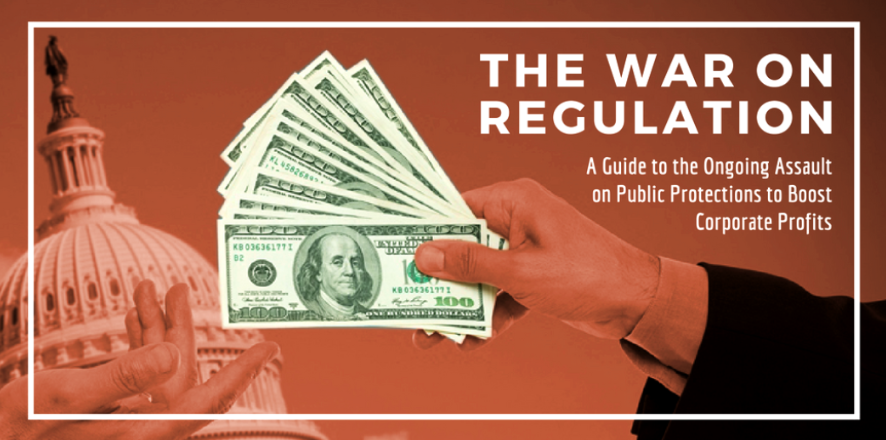
The War on Regulation: A Guide to the Ongoing Assault on Public Protections to Boost Corporate Profits

The war on regulation – carried out by the Trump administration, conservatives in Congress and private industry – is premised on a great deal of misinformation and misleading claims.  A recent report by the Coalition for Sensible Safeguards, a national alliance of more than 160 consumer, labor, scientific, research, public health and other groups, provides readers with what they  need to know to understand what’s at stake in the war on regulation and why regulatory safeguards matter. Read the full report.

2018 Lobbying and  Campaign Contributions from the Pharmaceutical and Food Industries

This week is Election Day and thanks to the Center for Responsive Politics  OpenSecrets.Org, the most comprehensive resource for federal campaign contributions, lobbying data and analysis available anywhere, voters can see what the Pharmaceutical/Health Care Products, Food and Beverages and other industries have spent on lobbying and campaigns contributions this election cycle and in the past.  The industries have already made their choices known in the 2018 midterm elections. Have you?

Total 2018 Lobbying Spending for Pharmaceuticals/Health Products Sector: $216,134, 421

Total Number of Clients Reported: 384

Total Number of Lobbyists Reported: 1,407

 2018 Campaign Contributions from this industry  $33.1 million 

 Pharmaceuticals/Health Products: Long-Term  Campaign Contribution Trends

Food and Beverages

Total  2018 Lobbying  Spending for Food & Beverage Sector: $22,393,837
Total Number of Clients Reported: 61
Total Number of Lobbyists Reported: 294                                                                                               Total Campaign Spending 2018:  $15 million

Food & Beverage: Long-Term Campaign Contribution Trends