How a flood of corporate funding can distort NIH research

Screen Shot 2018-06-28 at 7.38.46 PM


Credit

“This month, National Institutes of Health Director Francis Collins seemed to shut down a noxious ethical problem,” writes Paul Thacker, a former Senate staff member,  in The Washington Post. “The agency released a 165-page internal investigation of an alcohol consumption study that had been funded mostly by beer and liquor companies. The study’s lead investigator and NIH officials were in frequent contact with the alcohol industry while designing the study, which, according to the postmortem, seemed predetermined to find alcohol’s benefits but not potential harms, such as cancer. In several email exchanges published in the report, NIH scientists seemed to joke about taking a drink every time somebody said “cheers,” which was a proposed acronym for their study. Collins ended the trial and promised to create new ethical boundaries for how NIH officials deal with industry.  But the intellectual corruption at our government research agencies runs much deeper, and this was only the latest scandal involving hidden corporate influence. I spent 3 1 / 2 years as a Senate investigator studying conflict-of-interest problems at the NIH and the research universities it funds. During that time, I found that the agency often ignored obvious conflicts. Even worse, its industry ties go back decades and are never really addressed unless the agency faces media scrutiny and demands from the public and Congress for change.”

Corporate Efforts to Derail Mass Transit

Screen Shot 2018-06-22 at 10.30.05 PM

Credit

In 1985, two urban policy scholars, J. Allen Whitt and Glenn Yago,  wrote:

The urban transportation systems that carry us around are not solely the result of technological innovation or efficiency. They are also a product of the rising and sinking political and market power of industrial interest groups, the changing relations among social classes, the politics of urban development struggles, and the inherent dynamics of the economic system… These factors, particularly corporate control of transportation policy, have profoundly shaped urban streetcar, automobile, bus, and rail transport in the United States during this century. We conclude that this private dominance over urban transportation policy has often led to narrow, profit-seeking behavior that has thwarted the development of more effective public transit.

This week, The New York Times reported that in the last few years Americans for Prosperity, the conservative group financed by oil billionaires Charles and David Koch has contributed hundreds of thousands of dollars to defeat plans to expand or improve mass transit in  Little Rock, Phoenix, Nashville, southeast Michigan,  and central Utah. The group has also contributed to effort to defeat more than two dozen transit-related measures such as states proposals to raise gas taxes to fund transit or transportation infrastructure.

“Stopping higher taxes is their rallying cry”,  Ashley Robbins a transportation researcher at Virginia Tech, told The New York Times. “But at the end of the day, fuel consumption helps them.”   Although Americans for Prosperity opposes pubic spending on mass transit, it supports spending tax money on highways and roads.  Koch brother-owned industries produce gasoline, asphalt, seatbelts, tires and other auto parts, businesses that could be harmed by new investments in mas transit.

Public health research shows that improving mass transit and reducing automobile use can  bring multiple health and environmental benefits:  less premature mortality from lung disease, fewer asthma symptoms, more physical activity and less sedentary time, fewer injuries and deaths from auto crashes, more social interactions and less isolation, less road rage, more walkable and attractive  cities, less air pollution, reduced carbon emissions, less urban sprawl.

Despite these benefits, for more than a century public policy at the federal, regional, state and local levels has been disproportionately influenced by commercial interests that favor increased automobile use over the well-being of our population and our environment.  Public health professionals and researchers need to explore new ways to bring this debate about democracy, health and the environment into the policy and political arenas.

How do Americans rate the fairness of US corporate practices?

Screen Shot 2018-06-14 at 6.47.42 PM

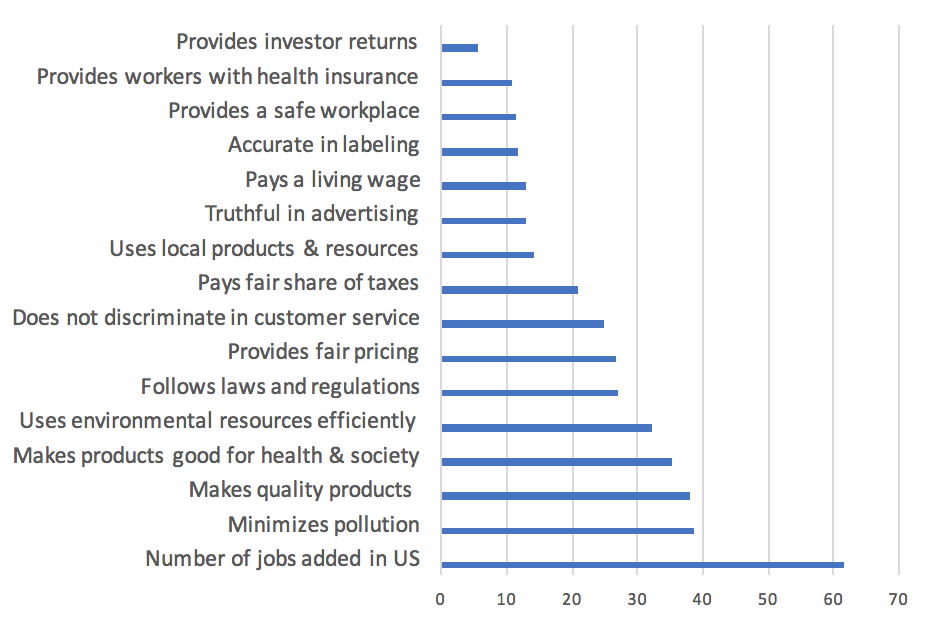
Responses to: Which of these behaviors is most important in evaluating how just a corporation is?   Source

What do Americans think of corporate practices?  And what business practices most disturb Americans?  Each year JUST Capital conducts a poll of a representative sample of U.S. adults to answer these questions.

JUST Capital, a nonprofit group, seeks to “build a more just marketplace that better reflects the true priorities of the American people.”  The group believes that “business, and capitalism, can and must be a positive force for change.”   We believe that if they have the right information, people will buy from, invest in, work for, and otherwise support companies that align with their values. And we believe that business leaders are searching to win back the trust of the public in ways that go beyond money. By shifting the immense resources and ingenuity of the $15 trillion private sector onto a more balanced – and more just – course, we can help build a better future for everyone.

The findings from its 2017 survey of about 4,100 adult US respondents, shown above, provides some informative insights.  First, the outcome most important to corporate managers, i.e., providing returns to investors, is the least important practice that respondents use to rate the fairness of a corporation. Second, the national discourse on jobs and job creation makes that practice by far the highest rated factor in judging a corporation’s fairness. Third, some of the practices of greatest interest to health advocates, such as the health consequences of products (rated as most important by 35.4% of respondents), efforts to minimize pollution (38.6%), and providing a safe workplace (11.5%) rank lower than other factors.

The survey also compares responses by several demographic characteristics, including age, gender, income, region, political party, ideology and investor status.  Of interest, none of these factors predict large differences in beliefs about fairness.  Any survey is of course influenced by the wording of questions and other surveys have shown age and other differences in how Americans view corporations.

JUST Capital provides more detailed reports of their annual surveys from 2014 to 2017. It also publishes Roadmap for Corporate America, its summary of the 2017 survey and recommendations for how corporations can respond to survey findings.