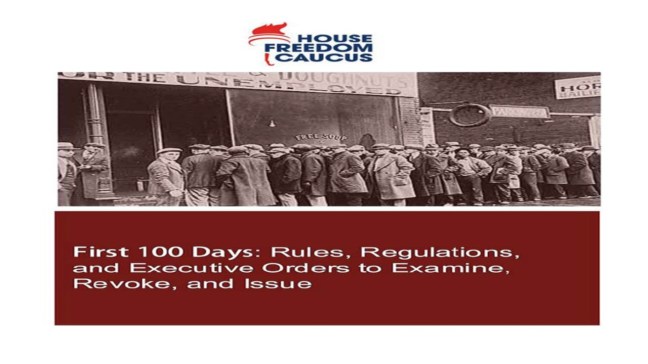
House Freedom Caucus Targets Regulations to Examine or Revoke in First 100 days

The Freedom Caucus of the U.S. House of Representatives, a group of more than 30 conservative Republicans,  released a report listing more than 200 federal rules and regulations that President-elect Donald J. Trump could wipe off the books after he takes office Jan. 20.  Among the public health measures on the proposed chopping block:
•    Nutrition standards for the school lunch and breakfast program
•    Various requirements for the USDA’s Food Safety and Inspection Service
•    FDA rules on tobacco
•    Coverage of preventive services under the Affordable Care Act
•    Various FDA rules that enable drugs that are unsafe or ineffective to be taken off the market.


High costs deter Americans from taking prescribed drugs

Congresswoman Rosa DeLauro has urged Labor, Health and Human Services Appropriations Subcommittee Chairman Tom Cole to revoke his hold on the Department of Health and Human Services (HHS) Report: Prescription Drugs: Innovation, Spending, and Patient Access. “By blocking the American people from seeing the HHS Drug Price report, Chairman Cole is denying the public critical information on spiraling drug spending in Medicare, Medicaid, and other federal health programs.” The full report is available here. The report found that almost 10% of U.S.  Adults aged 18-64 reported not taking drugs as prescribed because of the high costs.

The Scientific Basis of Guideline Recommendations on Sugar Intake: A Systematic Review

A review of the scientific basis of dietary guidelines for sugar intake supported by the sugar and soda industries and published in Annals of Internal Medicine concluded that these “Guidelines on dietary sugar do not meet criteria for trustworthy recommendations and are based on low-quality evidence. Public health officials (when promulgating these recommendations) and their public audience (when considering dietary behavior) should be aware of these limitations.” An editorial on the review criticized its methodology and conclusions. An author of the editorial told the New York Times that the writers of the review were “hijacking the scientific process in a disingenuous way to sow doubt and jeopardize public health.”

Gun Control Advocates Find a Deep-Pocketed Ally in Big Law

A new gun control strategy proposes more legal action to add to    demonstrations like the 2013 March on Washington. credit.

In Congress and in the Supreme Court, the gun lobby has racked up some crucial victories in recent years, writes the New York Times. It won again last month when Donald J. Trump, buoyed by the lobby’s money and support, secured an upset victory in the presidential election. On the defensive, gun control advocates are now quietly developing a plan to chip away at the gun lobby’s growing clout: Team up with corporate law firms. This effort is highly unusual in its scale. Although law firms often donate time to individual causes, and some firms have worked on gun control on a piecemeal basis, the number and the prominence of the firms involved in the new coalition are unheard-of for modern-day big law. Other firms are expected to join in the coming months.

The Trump Organization: Corporate Track Record

As Donald Trump moves into the White House next month, health advocates may find it helpful to review the business record of the Trump Organization, the real estate and development conglomerate he leads.  The Corporate Research Project, a nonprofit group that assists community, environmental and labor organizations in researching companies and industries, provides a summary of his record. For more than 30 years, Donald Trump has been almost continuously in the public eye, portraying himself as the epitome of business success and shrewd dealmaking, CRP writes. He took a business founded by his father to build modest middle-class housing in the outer boroughs of New York City and transformed it into a high-profile operation focused on glitzy luxury condominiums, hotels, casinos and golf courses around the world. Operating through the Trump Organization, his family holding company, Trump also capitalized on the name recognition gained through years of reality-television appearances in a wide range of licensing deals.

Health Activism Targeting Corporations: A Critical Health Communication Perspective

Health activists and health social movements have transformed medical treatment, promoted public health policies, and extended civil rights for people with illness and disability. This essay in Health Communications explores health activism that targets corporate-generated illness and risk in order to understand the unique communicative challenges involved in this area of contention. Arguing for greater critical engagement with policy, the article integrates policy research with social movements, subpolitics, and issue management literature. Drawing from activist discourse and multidisciplinary research, the article describes how a wide array of groups build visibility for corporate health effects, create the potential for networking and collaboration, and politicize health by attributing illness to corporate behaviors. The discussion articulates the implications of this activism for health communication theory, research, and practice.

Full citation: Zoller HM. Health Activism Targeting Corporations: A Critical Health. Communication Perspective. Health Commun. 2017 Feb;32(2):219-229.

The Public Health Burden of Alcohol and the Effectiveness and Cost-Effectiveness of Alcohol Control Policies: An evidence review

The distribution of drinkers in England. Credit

This review was commissioned by the Department of Health of England, which asked Public Health England (PHE) to provide an overview of alcohol-related harm in England and possible policy solutions. The report offers a broad and rigorous summary of the types and prevalence of alcohol-related harm, and evidence for the effectiveness and cost-effectiveness of alcohol control policies. Effectiveness is defined as the degree to which an intervention reduces the public health burden (health, social, and economic) of alcohol. The findings are interpreted within the English context and will be relevant to academics and researchers, public health professionals and policymakers in the health and non-health sectors. The review provides national and local policy makers with the latest evidence to identify those policies which will best prevent and reduce alcohol-related harm. It covers the following areas: taxation and price regulation, regulating marketing, regulating availability, providing information and education, managing the drinking environment, reducing drink-driving, and brief interventions and treatment.

New Report Exposes “Patient Advocacy” Groups as a Big Pharma Scam

“Patient advocacy” groups have a unique power on Capitol Hill, writes David Dayen in The Intercept.  They claim to represent the true voice of constituents, untainted by special interest bias. Politicians and the Food and Drug Administration use their endorsements as reflective of genuine public support. But a new study shows that nearly all of these patient advocacy groups are captured by the drug industry. David Hilzenrath at the Project on Government Oversight (POGO) reports that at least 39 of 42 patient advocacy groups who participated in discussions with the FDA over agency review processes for prescription drugs received funding from pharmaceutical companies. And at least 15 have representatives of drug or biotechnology companies on their governing boards. The study is particularly notable now because Congress is poised to pass the 21st Century Cures Act, which trades temporary additional funding for the National Institutes of Health and the FDA for permanent weakening of the FDA’s approval process. Over 1,400 lobbyists have been working on this bill, which would be a major financial boon to the drug and medical device industries.

The Absurd, Illegal Logic Behind Trump’s ‘Two for One’ Regulation Proposal

The president-elect recently described in a YouTube video what he intends to do on his very first day in office, writes Ken Kimmell on InsideSources.  Among other things, he will issue a new command to all federal agencies: “If you want to issue a new regulation, you must repeal two existing ones.”  So, for example, if the Environmental Protection Agency wants to issue a new rule to protect kids from mercury pollution from power plants, it would need to cut two existing rules, such as reducing lead in drinking water or requiring school buses to cut smog-causing emissions. Or if the Consumer Product Safety Commission wants to protect families from dangerous car seats for children, the commission would need to drop rules such as requiring better labeling of age appropriate toys, or reducing toxic substances in baby products.  As these examples illustrate, the idea is absurd. Agencies issue multiple regulations because there are multiple threats to public health, safety and the environment. Each regulation must be judged on its own merits. If a new regulation is warranted, it should be issued. If an existing regulation is outdated or no longer effective, it should be changed. One shouldn’t be held hostage for the other.

Nutritionism, Big Food and the Corporate Capture of Nutrition

In response to growing pressure from eaters who want healthier food, governments that want to take action to protect public health and reduce the costs of diet-related diseases,  and competitive markets that jeopardize profits, global big food companies have launched a multi-pronged campaign to protect their interests.  One element of this campaign is to use nutrition science to justify its actions, a process that some have called “nutritionism”. Nutritionism provides a halo for corporations, legitimizes existing and growing markets for highly processed foods, and helps to preempt and deter direct government regulation.  Three key strategies food companies use to practice nutritionism are fortification, reformulation, and functionalization.  In a talk at the City University of New York School of Public Health entitled “Nutritionism, Big Food and the Corporate Capture of Nutrition”, Gyorgy Scrinis, Senior Lecturer in Food Politics and Policy at the University of Melbourne, analyzed how corporations use nutrition and nutritonism to advance their business interests. Gyorgy is also the author of Nutritonism The Science and Politics of Dietary Advice (Columbia University Press, 2013.) View the presentation.

Read a related article: Scinis, G. Reformulation, fortification and functionalization: Big Food corporations’ nutritional engineering and marketing strategies, The Journal of Peasant Studies 2016; 43 (1):17-37.