ABC News reports that the nation’s tobacco companies and the Justice Department are including media outlets that target more of the black community in court-ordered advertisements that say the cigarette makers lied about the dangers of smoking, according to a brief filed in U.S. District Court in Washington on Wednesday. The advertisements are part of a case the government brought in 1999 under the Racketeer Influenced and Corrupt Organizations.
General Mills Proposes, Then Withdraws Limits On Class Action Lawsuits
Huff Post writes that General Mills, the cereal company, last week revealed a new rule that prevented people from joining class action lawsuits if they “joined [its] online communities.” Such actions might include company contest, or liking the company on Facebook. Those who violated the rule would have been limited to arbitration or informal negotiations as a means of conflict resolution. But in a blogpost on its corporate website a few days later, General Mills said it was changing back to its old legal terms.
How Big Chicken Took Over America

reposted from Al Jazeera

Last month, an unusual scuffle played out between two federal agencies over a controversial proposal by the U.S. Department of Agriculture to increase the speed of kill lines for poultry in slaughterhouses. But with testing from Consumer Reports last year revealing that 97 percent of raw chicken breasts purchased at retailers are contaminated with harmful bacteria, and with poultry workers already suffering from numerous job-related injuries, advocacy groups are vigorously opposed to the idea. The rule would also reduce the number of USDA inspectors required to ensure food safety, transferring some of that responsibility to the chicken and turkey companies themselves. But as one former inspector (who worked both for the USDA and the chicken industry) warned, plant workers are not properly trained for inspection, and they are too scared for their jobs to speak up. That’s why groups such as Food and Water Watch are taking out newspaper ads calling the proposal the “Filthy Chicken Rule.”
Ever since the idea was first floated in 2012, food safety and worker advocacy groups have been complaining that the USDA is putting profits over health and safety. In March, 68 members of Congress sent a letter charging the agency with inadequately addressing serious concerns about public health, worker safety and animal welfare.
In the wake of the controversy, the National Institute for Occupational Safety and Health (NIOSH) released a study (PDF) that expressed grave concerns for worker safety — from musculoskeletal disorders to traumatic injuries — after reviewing data from a Pilgrim’s Pride poultry processing plant in South Carolina. Yet to prop up its flawed proposal, the USDA twisted those findings into good news, claiming that “the increase in evisceration line speeds was not a significant factor in worker safety.” (The USDA does not have jurisdiction over worker safety — the Occupational Safety and Health Administration does — so its line speed rule can ignore workers.) In a highly unusual rebuke, the director of the NIOSH wrote a public letter on April 7 chastising the head of the USDA’s Food Safety and Inspection Service for misinterpreting the data and making “misleading” statements.
Safety last on kill lines
But let’s back up a bit. As Mother Jones magazine explained last year, “Currently, each factory-scale slaughterhouse has four USDA inspectors overseeing kill lines churning out up to 140 birds every minute. Under the USDA’s new plan, a single federal inspector would oversee lines killing as many as 175 birds per minute.”
USDA Secretary Tom Vilsack defends the proposal under the guise of modernization (an industry code word for deregulation) and claims the new standard would actually reduce bacterial contamination. However, Food and Water Watch found numerous food safety problems with the USDA’s pilot project owing to company inspectors missing defects such as “feathers, lungs, oil glands, trachea and bile still on the carcass.”
The rule is especially terrible for workers, who already suffer unsafe conditions, resulting in serious injuries and even lifelong disabilities. Last year the Southern Poverty Law Center released a disturbing account of worker injuries and health problems in Alabama poultry slaughterhouses due to what it called “punishing” line speeds. Workers were made to “endure debilitating pain in their hands, gnarled fingers, chemical burns and respiratory problems.” Also, for many immigrant workers, as the law center put it, “Threats of deportation and firing are frequently used to keep them silent,” making the USDA’s attempt to spin the recent NIOSH data particularly disturbing.
Federal agencies appear to be ganging up on the USDA — and rightly so. The Government Accountability Office published a report last year criticizing the USDA’s plan on the basis of inadequate and faulty safety data. Of course, the chicken industry loves the proposal. In fact, the National Chicken Council would prefer not having any limits on line speeds at all.
Failing on antitrust
None of this comes as a surprise to Christopher Leonard, a fellow at the New America Foundation and author of the recently released book “The Meat Racket,” a stunning history of the rise of Tyson Foods — the world’s largest meat company, spanning beef, chicken and pork — and how it transformed the entire chicken industry.
Leonard told me the proposed rules are just another sign of the power of the meat industry. Not showing much confidence in the USDA’s leadership, he said, “It shows what kind of laws can effectively be passed under the tenure of Tom Vilsack.”
The devastating effects of meat industry consolidation on rural America are vastly underreported and largely ignored by policymakers.
The meat industry is so powerful because over the decades, production has consolidated into the hands of a few players. As a result, small farmers and ranchers have either been squeezed out or made to operate under challenging conditions; with so little competition, the major players call the shots. That’s why as a presidential candidate (and in his “Blueprint for Change”) Barack Obama touted the importance of meat industry economic reform. Specifically, he promised to “strengthen anti-monopoly laws and strengthen producer protections to ensure independent farmers have fair access to markets, control over their production decisions, and fair prices for their goods.” The USDA did try to enforce antitrust law and promulgate new regulations to protect farmers and ranchers from unfair business practices. But after much internal debate at the USDA (and with the White House) that resulted in key agency staffers resigning in disgust, the final rule was all but gutted.
The Obama administration ultimately caved to industry pressure, which took the form, in part, of an information campaign that portrayed the proposal to protect small producers “as the first step toward economic ruin of the meat business,” according to Leonard. This sky-is-falling scaremongering is a typical industry tactic to maintain the status quo.
The failed attempt to enforce antitrust law in the meat industry proved to be an especially painful experience for the many farmers and ranchers who attended a series of workshops co-hosted by the USDA and the Department of Justice in 2010. The idea was for the feds to hear directly from the small producers to learn about the challenges they face. I attended the last event in Washington, D.C., and talked to chicken growers from Arkansas who had come to the capital to share their struggles, such as earning only pennies on the dollar for their labor. But as “The Meat Racket” shows, the devastating effects of meat industry consolidation on rural America are vastly underreported and largely ignored by policymakers.
Leonard’s book dramatically describes how Tyson pioneered the vertically integrated system, in which the company owns every step of production, from hatching the eggs to slaughtering and packaging the final products. One step in the process remains “independent” because it’s the least profitable: raising the birds. Still, Tyson retains very tight controls over the growers and their operations, resulting in a kind of serf system. One chicken grower from North Carolina told the USDA at one of the 2010 hearings: “This system takes hardworking farmers and makes them indentured servants on their own land. I can’t tell you how many times I’ve heard that our contract would be canceled if we did such and such.”
Big Chicken running scared
The National Chicken Council, according to Leonard, “started attacking the book within hours of its publication,” posting one-star reviews on Amazon, putting up a page on its website called “Meat Racket Myths” (PDF) and circulating the Twitter hashtag #meatracketmyths. But Leonard said he was most surprised by “the deluge of anonymous people from inside the industry who thanked me for writing the book. Many of them — manager types who work for Tyson and ConAgra — said that things are worse than I portrayed them.”
What is the chicken industry so afraid of? Maybe it’s that if too many people hear the real story about meat production in this country and learn more about the industry’s unsavory practices, they will realize that the heartless corporation behind their boneless chicken patty is destroying rural America. As Leonard told me, “Consumers don’t want to think that the American farmers raising their meat are ensnared in a form of modern sharecropping. The chicken lobby knows how indefensible most of these practices are, so they have to attack the messenger rather than entertaining the truth, which might lead to reform.”
Those reforms would include slowing down, not speeding up, the kill lines in poultry slaughterhouses to improve safety for workers and consumers; ensuring that farmers and ranchers are paid a fair price for their hard work; and enforcing antitrust laws to encourage a more competitive marketplace. But these are the sorts of reforms that we seem to hear about only in campaign promises.
Jamira Burley Honored as White House Champion of Change for Gun Violence Prevention
“Since the murder of my brother Andre in 2005, I have worked to prevent my peers from experiencing the same adversities that I did. Whether that means training the next generation of city leaders through my job at the Philadelphia Youth Commission, or meeting with members of Congress regarding common-sense gun legislation. Nine years ago I did not choose this work, it chose me.”
Climate Change and Food Security
Food & Climate: Connecting the Dots, Choosing the Way Forward, a new report by the Center for Food Safety, warns that climate change “has the potential to damage irreversibly the natural resource base on which agriculture depends” and could create widespread scarcity, economic disruption, and social unrest, with grave consequences for global food security.
Gateway to Addiction? A Survey of Popular Electronic Cigarette Manufacturers and Targeted Marketing to Youth
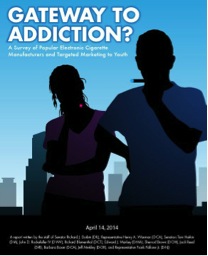
Below are the Executive Summary and Key Findings from this report:

Electronic cigarettes, also known as e-cigarettes, are battery-operated products designed to deliver nicotine, flavor and other chemicals.(1) They contain cartridges filled with flavors and chemicals, including the highly addictive substance nicotine, which are vaporized into an aerosol that is inhaled by the user. Many e-cigarettes are manufactured to look like conventional cigarettes and mimic the act of smoking.(2)
According to the Centers for Disease Control and Prevention (CDC), e-cigarette use is growing rapidly.(3) However, these products are currently not subject to federal laws and regulations that apply to traditional cigarettes. For example, federal laws and regulations prohibit traditional cigarettes from being sold to persons younger than 18 years of age, distributed as free samples, advertised on television and radio, and having characterizing candy and fruit flavors that appeal to children. There is no federal ban on the use of such tactics by e-cigarette manufacturers. In the absence of federal regulation, some e-cigarette manufacturers appear to be using marketing tactics similar to those previously used by the tobacco industry to sell their products to minors. To address growing questions over e-cigarettes and the marketing of these products, on September 26, 2013, Senator Richard J. Durbin (D-IL), Representative Henry A. Waxman (DCA), Senator Tom Harkin (D-IA), Senator John D. Rockefeller IV (D-WV), along with Senators Richard Blumenthal (D-CT), Edward J. Markey (D-MA), Sherrod Brown (D-OH), Jack Reed(D-RI), Barbara Boxer (D-CA), Heidi Heitkamp (D-ND), Jeff Merkley (D-OR), and Representative Frank Pallone Jr. (D-NJ) launched an investigation into the practices of nine commonly sold e-cigarette brands. This report draws from written responses provided by the companies in response to this investigation. In instances where companies did not provide complete responses or simply did not respond to a question, supplemental information was gathered from company websites and through reviewing other publically available information.
Findings in Brief
The findings of this analysis demonstrate the need for the Food and Drug Administration (FDA) to act quickly to issue e-cigarette regulations.
Major findings:
- All surveyed companies appear to use various marketing practices that appeal to youth.
For instance:
- Eight e-cigarette companies promote their products through sponsored or sampling events, many of which appear to be youth-oriented. In 2012 and 2013 alone, six of the surveyed companies sponsored or provided free samples at 348 events.(4)
- Seven e-cigarette companies air television and radio advertisements during events and programs, including those with youth viewership. Blu’s commercials “have aired thousands of times at various times of the day and night on 48 networks,” and NJOY has advertised during programs including the Super Bowl, an event that reaches a substantial audience of youth under age 18.
- Six e-cigarette companies market e-cigarettes in flavors that could appeal to children and teens. For example, e-cigarette manufacturers are marketing flavors like Cherry Crush, Chocolate Treat, Peachy Keen, and Grape Mint.
- E-cigarette manufacturers have significantly increased marketing spending, more than doubling expenditures between 2012 and 2013. In total, six e-cigarette companies spent $59.3 million in 2013 to market e-cigarettes.
Additional findings:
- There is wide variation in e-cigarette industry point-of-sale practices. One e-cigarette company reported that it does not maintain any policy barring sales to minors. Other companies have policies barring such sales, but these vary in scope and the level of company oversight.
- Four e-cigarette companies use celebrity spokespeople to market their products and depict e-cigarette smoking as glamorous. For example, celebrities have appeared in advertisements and at a prominent music festival.
- Seven e-cigarette companies utilize social media to promote their products. While some companies impose age restrictions to prevent youth access to their Facebook, Twitter, and YouTube content, three companies – Eonsmoke, VMR, and Lead by Sales – do not utilize any age restriction options for social media accounts.
- E-cigarette product warning labels lack uniformity and may confuse consumers. While some manufacturers’ warning labels are succinct, make clear that e-cigarettes don’t offer health benefits, and detail the health risks associated with nicotine, others do not.
- Six e-cigarette companies support some form of regulation, such as restrictions on the sale and marketing of e-cigarettes to children and teenagers, a ban of the usage of television to market e-cigarettes, a prohibition on characterizing flavors, restricting online sales, and regulation of e-cigarettes at the point-of-sale.
References
1. fda.gov/newsevents/publichealthfocus/ucm172906.htm).
2. Legacy Foundation, E-cigarette policy: the FDA should promptly exercise regulatory authority over ecigarettes (January 2014).
3. Centers for Disease Control and Prevention, Notes from the Field: Electronic Cigarette Use Among Middle and High School Students – United States, 2011-2012 (Sept. 6, 2013) (online at http://www.cdc.gov/mmwr/preview/mmwrhtml/mm6235a6.htm).
4. Altria has held sampling events but declined to provide an itemized list; R.J. Reynolds provided a list of all locations where sampling events were held through October 31, 2013. The total number of events in 2012 and 2013 is based on the conservative assumption that one event was held at each of the R.J. Reynolds’ sampling locations.
General Motors Quick Guide to Crisis Management
Nearly fifty years ago, shortly after Ralph Nader’s 1965 book Unsafe at Any Speed charged that General Motors knowingly distributed Chevrolet Corvairs despite design defects, GM CEO James Roche hired former FBI agent Vincent Gillen to investigate Nader to, in Gillen’s words “ determine what makes him tick,” examining “his real interest in safety, his supporters if any, his politics, his marital status, his friends, his women, boys, etc., drinking, dope, jobs, in fact all facets of his life.”

The recent media and Congressional investigations of General Motors decision not to replace a defective ignition switch on Chevrolet Cobalts –a part that cost less than one dollar—despite evidence that the defect had contributed to more than a dozen deaths again put the spotlight on GM. And once again, GM senior management seemed to be consulting the same playbook that Roche had apparently followed in responding to Nader’s charges. According to the New York Times, although the company learned in 2009 that a potentially fatal defect existed in hundreds of thousands of cars, for the next five years, “GM told the families of accident victims and other customers that it did not have enough evidence of any defect in their cars… In one case, GM threatened to come after the family of an accident victim for reimbursement of legal fees if the family did not withdraw its lawsuit. In another instance, it dismissed a family with a terse, formulaic letter, saying there was no basis for claims.”
From a review of this record of five decades, we’re pleased to offer General Motors Quick Guide to Crisis Management. We hope this will help GM managers and other corporate leaders to respond rapidly when the next round of design defects is revealed.
1. Ignore the problem in the hope it will go away.
The first step in corporate crisis management is to hope for the best. Creating a communications system that keeps engineering, safety, legal and public relations departments units separate also helps. After all, you can’t be liable for what you don’t know, can you?
2. Withhold relevant information from regulators.
Regulators can’t take action in problems they don’t know about. GM failed to report the defect to the National Highway Transportation and Safety Administration (NHSTA) for years. Last week NHTSA Administrator David Friedman testified before Congress that his agency would have acted differently had GM not withheld information.
3. Attack and threaten your critics.
In the unlikely event that a problem does come to light, warn your critics that further action could result in lawsuits, staggering legal fees and smear campaigns. GM emphasized that several of those killed in the Cobalt crashes had been drinking prior to the event. It also threatened families contemplating lawsuits that GM would aggressively seek to require these families to pay the company’s legal fees.
4. Apologize, apologize and apologize.
In the unlikely event the company is caught misrepresenting the record of what it knew when, company executives are urged to apologize profusely and repeatedly.
At the 1966 Senate hearing to examine GM safety record and its investigation of Ralph Nader, CEO Roche explained to the committee that GM had begun its investigation of Nader to determine if Nader was involved in the Corvair damage claims. He testified, “I am not here to excuse, condone or justify in any way our investigation” of Nader. He deplored “the kind of harassment to which Mr. Nader has apparently been subjected” and was “just as shocked and outraged” as the senators were.
And last month, Mary Barra, the current CEO of GM said, “Something went very wrong in our processes in this instance, and terrible things happened.” At subsequent Congressional hearings, media interviews and meetings with families of Cobalt victims, she has apologized more than a dozen times.
5. Hire experts to give some time and deflect legal or regulatory action.
GM has hired a raft of experts to conduct internal investigations of the Cobalt affair. It has also hired Ken Feinberg, the master craftsman of plans to manage corporate risk after disasters to come up with a possible compensation plan for victims and their families.
6. Lobby aggressively to protect industry against undue regulatory influence.
Media attention on auto defects waxes and wanes but it is Congress who writes the laws that regulate the auto industry. To ensure a welcome reception on Capitol Hill, GM lobbies aggressively in good times and bad. In 2013, GM reported spending $8.8 million on lobbying. According to Open Secrets, between 2002 (when the parts maker Delphi first told GM there was a problem in the ignition switch that was later installed in Cobalts) through 20013, GM spent more than $114 million on federal lobbying.
7. Support auto friendly politicians.
Since 1989, according to the Sunlight Foundation, GM has contributed more than $12.3 million dollars to candidates in federal campaigns. Its top 10 recipients include 5 Democrats and 5 Republicans, showing the company’s commitment to bipartisan appeals to currying favor.
Unfortunately, even these steps can’t guarantee that all problems will go away. But in the long run, they help GM to keep its focus on profitability and to manage the inevitable distractions from that goal.
Underage Youth and Adults Differ in their Alcohol Brand Preferences
A new report published online by Substance Abuse finds that youth are not merely mimicking the alcohol brand choices of adults but choose to disproportionally consume brands such as Keystone Light beer, Bacardi malt beverages, Malibu rum, Captain Morgan rum and Smirnoff malt beverages. This suggests that other factors may influence youth drinking preferences.
Pharmaceutical Marketing Expenses in District of Columbia, 2012
According to a new report prepared by the George Washington School of Public Health and Health Services for the District of Columbia municipal government, 147 pharmaceutical manufacturers and labelers reported marketing expenditures of $97.5 million in 2012, which represents the first year‐on-year increase in such spending since 2007. The reported amount included expenses for local pharmaceutical sales representatives, speaking fees and gifts to physicians, and free samples.
33 Leading Public Health Groups Urge FDA to Regulate Tobacco More Vigorously
In response to the Surgeon General’s latest report on the health consequences of smoking, thirty-three leading public health and medical organizations are urging the U.S. Food and Drug Administration to make it a priority to regulate how cigarettes are manufactured and stop tobacco industry practices that have made cigarettes even more deadly and addictive than they were 50 years ago.
 Corporations and Health Watch