Taxing for health

Credit

Taxing products that harm health has long been part of the public health’s armamentarium to reduce the impact of harmful corporate practices. As the global economic crisis continues and the austerity mentality feeds government hunger for new sources of support, politicians look for   streams of   revenue that can win public support.    Recent media coverage of several political debates about taxes designed to promote health illustrate the potential and pitfalls of this strategy.


In France, the new socialist government has proposed a new tax on beer that would increase the price of a half pint of beer by six cents.  According to the New York Times, the government offers a public health rationale for the beer tax. There has been an “excessive alcoholization, in particular of youth, with beer more than with wine,” said Jérôme Cahuzac, the budget minister. French beer taxes are among the lowest in the 27-state European Union, he noted, and the scheduled increase would leave them only the 10th highest, lower than in Britain, Spain and the Netherlands.


The Socialist government has also said it will increase the value-added tax, a type of consumption tax, in several sectors of the food industry, including restaurant meals, to 10 percent from 7 percent, partly reversing a reduction made by the previous center-right government.  In addition, France’s social security budget, which is in the final stages of the legislative process, also includes heavier taxes on tobacco and new ones on energy drinks. Proposed new taxes total about $30 billion; the increase in the beer tax is expected to generate an additional $625 million.


Not surprisingly, bar owners oppose the new tax, fearing it will cut their business.  Others complain that the tax increase is just on beer, not wine, an important sector of the national economy. One supporter of the bill, Even Gérard Bapt, a Socialist legislator, expressed the opinion that the “increase would have to be much more significant to have a real moderating effect on consumption.”


While the socialist government in France is proposing new consumption taxes,  Danish lawmakers from the center-right party  earlier this month have killed a controversial “fat tax” one year after its implementation, reports the Wall Street Journal.  They acted after deciding its negative effect on the economy and the strain it has put on small businesses outweighed the health benefits.


The new tax led to increases of up to 9 percent on products such as butter, oil, sausage, cheese and cream. “What made consumers upset was probably that an extra tax was put on a natural ingredient,” Sinne Smed, a professor at the Institute of Food and Resource Economics in Copenhagen, told the Journal.


The fat tax brought an estimated $216 million in 2012 in new revenue.  To make up for the lost revenue, Danish lawmakers will raise income taxes slightly and reduce personal tax deductions. The lawmakers also reversed an earlier decision to create a sugar tax. The fat tax was created in 2011 to address Denmark’s rising obesity rates and relatively low life expectancy. There is little evidence the tax impacted consumers financially, reports the Journal,  but it did spark a shift in consumer habits. Many Danes have bought lower-cost alternatives, or in some cases hopped the border to Germany, where prices are roughly 20% lower, or to Sweden.


In a commentary in the New Scientist on the repeal of Denmark’s fat tax Marion Nestle, the New York University nutritionist, disputed the contention that Denmark’s decision was based on health:


Nobody likes taxes, and the fat tax was especially unpopular among Danish consumers, who resented having to pay more for butter, dairy products and meats – foods naturally high in fat. But the real reason for the repeal was to appease business interests. The ministry of taxation’s rationale was that the levy on fatty foods raised the costs of doing business, put Danish jobs at risk and drove customers to buy food in Sweden and Germany…. Governments must decide whether they want to bear the political consequences of putting health before business interests. The Danish government cast a clear vote for business.  At some point, governments will need to find ways to make food firms responsible for the health problems their products cause. When they do, we are likely to see immediate improvements in food quality and health. Let’s hope this happens soon.


Credit


Another approach to public health taxes has been suggested by outgoing Ohio Congressman Dennis Kucinich. He has proposed a bill HR 4310 End The Childhood Obesity Subsidy Act that would prohibit any company from claiming a tax deduction for the expense of marketing that is directed at children “to promote the consumption of food at fast food restaurants or of food of poor nutritional quality.”  In a November press release and video, Kucinich argues:


According to the Institute of Medicine, ‘Aggressive marketing of high-calorie foods to children and adolescents has been identified as one of the major contributors to childhood obesity.’ We can end this tax break, improve our kids’ health and reduce our nation’s debt all at the same time. It’s time to stop subsidizing the childhood obesity epidemic.


Under current law, the federal tax code allows companies to deduct “reasonable and necessary” expenses of marketing and advertising from their income taxes. Fast food marketers get the same break that other businesses do.


So what do these three recent stories from different parts of the world tell us about the use of taxation to promote health and end harmful corporate practices?


First, taxes on products that harm health will always generate intense opposition from a variety of business interests, from local retailers to the world’s largest corporations.  Advocates who propose such taxes better expect such opposition and be ready to counter it. 


Second, finding the balance between a level of taxation that will actually discourage use and one that is politically feasible in a particular context requires scientific analysis of the available literature and political analysis of the opportunities and constraints.  A May 2012 review in the British Medical Journal concluded that


Taxes on unhealthy food and drinks would need to be at least 20% to have a significant effect on diet-related conditions such as obesity and heart disease. Ideally, this should be combined with subsidies on healthy foods such as fruit and vegetables, they add.


Advocates need to assess the potential for achieving health goals with a proposed tax and consider the pros and cons of a variety of alternative strategies before deciding to pursue the tax route.


Finally, as Kucinich’s proposal suggests, changing the tax code to promote health is not limited to taxes that lead to direct increases in consumer prices.   Dozens of corporate subsidies enable low prices for unhealthy products and supporting changes in taxation that limit these subsidies may offer promoting political opportunities for discouraging harmful corporate practices.  Given the key role that marketing plays in promoting unhealthy behaviors, environments and lifestyles, a closer analysis of tax subsidies for advertising that harms health seems warranted. 

  

The alcohol industry’s plan to give America a giant drinking problem

Why has the United States, so similar to Great Britain in everything from language to pop culture trends, managed to avoid the huge spike of alcohol abuse that has gripped the UK? Tim Heffernan asks in the Washington Monthly.   The reasons are many, he writes,  but one stands out above all: the market in Great Britain is rigged to foster excessive alcohol consumption in ways it is not in the United States—at least not yet. By deliberately hindering economies of scale and protecting middlemen in the booze business, America’s system of regulation was designed to be willfully inefficient, thereby making the cost of producing, distributing, and retailing alcohol higher than it would otherwise be and checking the political power of the industry.

Judge orders tobacco companies to say they lied

A federal judge on Tuesday ordered tobacco companies to publish corrective statements that say they lied about the dangers of smoking and that disclose smoking’s health effects, including the death on average of 1,200 people a day. Business Week reports that Judge Gladys Kessler ordered tobacco companies to publish corrective ads stating that a federal court has concluded that the defendant tobacco companies “deliberately deceived the American public about the health effects of smoking” and “that smoking kills more people than murder, AIDS, suicide, drugs, car crashes and alcohol combined, and that “secondhand smoke kills over 3,000 Americans a year.”

Corporations, human rights violations, and the U.S. Supreme Court

 On October 1, 2012, the U.S. Supreme Court heard oral arguments for Kiobel v. Royal Dutch Petroleum, a case that concerns the legal treatment of corporations accused of committing human rights violations overseas.


Kiobel is a class action brought by current and former residents of Nigeria, in the Ogoni region, against Royal Dutch Petroleum for alleged conduct in Nigeria in the 1990s. Starting in the late 1950s, Shell Petroleum Development Company of Nigeria, which now falls under the umbrella of Royal Dutch Petroleum, entered Nigeria’s Ogoni region to explore its oil-producing potential. A local group, known as the Movement for Survival of Ogoni People, began to protest these activities out of concern for their impact on the environment. Esther Kiobel (the widow of one of the protestors) and the other plaintiffs allege that, from 1993 to 1994, Royal Dutch Petroleum responded to these actions by working with Nigerian military forces that assaulted, raped, and murdered some of the protestors.[1]


Kiobel’s claim was made under the Alien Tort Statute, a U.S. law enacted in 1789.[2] The statute allows U.S. courts to hear lawsuits over alleged overseas “violation[s] of the law of nations,” also known as customary international law. For a U.S. court to have jurisdiction over a case, the alleged perpetrators must conduct business or otherwise have a presence in the United States. At the time it was passed, the Alien Tort Statute was likely envisioned as a legal tool to address piracy and crimes committed against ambassadors.[3] In 2010, the U.S. Court of Appeals for the 2nd Circuit held that only individuals—not corporations—could be held liable through a claim brought under the Alien Tort Statute. The appellate court explained that, because corporate liability is not a universally accepted concept within customary international law, the Alien Tort Statute could not be employed as a tool to hold corporations liable for international human rights violations. The court noted, however, that individuals could be found liable for such violations under the Alien Tort Statute.[4]


The U.S. Supreme Court originally heard oral arguments for Kiobel in February 2012, with a focus on whether corporations could be sued for alleged overseas human rights violations under the Alien Tort Statute.[5] One month later the Court requested additional oral arguments, which were held in October 2012. This time, the Court specified that the arguments should focus on whether the Alien Tort Statute allows U.S. courts to have jurisdiction over cases that concern activities that occurred outside of the United States.


Interestingly, the last time that the Supreme Court requested additional oral arguments was in 2009, for the Citizens United v. Federal Election Commission case, which the Court decided in 2010.[6] That case concerned the desire of the non-profit corporation Citizens United to promote its movie, Hillary: The Movie—which offered an unflattering portrait of Hillary Clinton—throughout the presidential primaries in 2008. Lower courts had determined that Citizens United could not use television advertisements to promote the film, as this would have violated laws that determined how corporations could engage in political speech.[7]


The U.S. Supreme Court overturned these lower court decisions and, with its Citizens United opinion, expanded the ability of corporations to use their own monies for political speech (i.e., advertisements for or against candidates in advance of an election).[8] The decision received significant attention from the media, as it dramatically altered the role that corporations could play in the political process. As evidenced by the recent presidential and congressional election cycles, corporations now have a more prominent voice in U.S. elections compared to the role that they played before the increased financial freedom granted by Citizens United.


While the Kiobel case raises very different types of legal concerns than those addressed by Citizens United, it has similarly captured the attention of the business community and other stakeholders due to its implications for corporations. For example, the U.S. Chamber of Commerce filed an amicus brief, also known as a friend-of-the-court brief, in support of Royal Dutch Petroleum. The Chamber of Commerce has summarized its position as follows:


“[E]fforts to expand civil liability under the 1789 Alien Tort Statute (ATS) would interfere with U.S. foreign relations, and would have severe economic consequences not just on the domestic economy—by discouraging investment by foreign companies reluctant to be exposed to American-style litigation—but also on developing and post-conflict countries, particularly those where the U.S. government has enlisted the aid of American businesses to ‘constructively engage’ them through commerce.”[9]


Groups such as the Center for Constitutional Rights have filed amicus briefs in support of the Kiobel and the other plaintiffs, arguing that “a general principle of law exists supporting corporate liability and that this principle supports a finding that corporations can be held liable under the ATS.”[10] An amicus brief submitted by Ambassador David J. Scheffer echoes this point. In his brief, he writes: “The Circuit Court majority’s judgment abandoning corporate liability under the Alien Tort Statute . . . stands in stark contrast to the growing number of nations that have embraced corporate liability for atrocity crimes.”[11]


As these arguments suggest, stakeholders believe that the Court’s decision will have a major impact on the global business community and international human rights. The case gives the Court an opportunity to again consider whether corporations should, under the law, be treated in the same way as actual people. In Citizens United, the Court expanded corporations’ political speech rights, bringing them more in line with those enjoyed by actual people. In the appellate court’s treatment of Kiobel, the Second Circuit found that the Alien Tort Statute could apply to actual people but not to corporations. In the coming months, the U.S. Supreme Court will decide whether this distinction will be upheld, with important implications for both corporations and individuals in the U.S. and overseas.


Sarah O. Rodman is a doctoral student in Health Policy and Management and a pre-doctoral fellow at the Center for a Livable Future at the Johns Hopkins Bloomberg School of Public Health.


References


[1] Kiobel v. Royal Dutch Petroleum Co., 621 F.3d 111 (2nd Cir. 2010).

[2] Alien Tort Statute, 28 U.S.C. § 1350 (2012).

[3] Sosa v. Alvarez-Machain, 542 U.S. 692 (2004).

[4] Kiobel v. Royal Dutch Petroleum Co., 621 F.3d 111 (2nd Cir. 2010).

[5] P. Weiss, Should corporations have more leeway to kill than people do? NY Times (Feb. 24, 2012).

[6] A. Liptak, Justices begin term by hearing case again. NY Times (Oct. 1, 2012).

[7] L. Rutkow, J.S. Vernick, S.P. Teret, The potential health effects of Citizens United, N Engl J Med. 2010;362:1356-1358.

[8] Citizen United v. Federal Election Commission, 558 U.S. 310 (2010).

[9] National Chamber Litigation Center, U.S. Chamber of Commerce, Kiobel, et al. v. Royal Dutch Petroleum, http://www.chamberlitigation.com/kiobel-et-al-v-royal-dutch-petroleum.

[10] Center for Constitutional Rights, Kiobel v. Royal Dutch Petroleum Co., http://ccrjustice.org/ourcases/current-cases/kiobel.

[11] Brief of Ambassador David J. Scheffer in Support of the Petitioners, http://harvardhumanrights.files.wordpress.com/2012/01/brief-of-ambassador-david-j-scheffer-12-20-11.pdf.

18 of 26 losing incumbent House members endorsed by the National Rifle Association

For years, the media has claimed  that the National Rifle Association is an electoral powerhouse with a real ability to impact the outcomes of elections. The 2012 elections clearly demonstrate that the conventional wisdom is at odds with reality. While most incumbents in the House of Representatives kept their seats on November 6, over two-thirds of incumbents who lost were backed by the NRA. In a post on Media Matters for America, Timothy Johnson describes the fate of NRA backed candidates. 

More choices but no decline in calories at major fast food outlets

Although the number of lunch and dinner menu items offered by leading fast-food chain restaurants has increased by 53% between 1997 and 2010, there have been few changes in the energy content of these offerings, according to a new study published in the November issue of the American Journal of Preventive Medicine.  Despite efforts by the industry to promote more healthful choices, the major outlets have made limited changes in the energy content of fast-food offerings.

New report on tobacco industry in China

According to a new report from The Brookings Institution, The Political Mapping of China’s Tobacco Industry and Anti-Smoking Campaign, the high prevalence of tobacco use in China is not only the country’s single most serious public health problem, but also constitutes the ultimate test case for the global tobacco control campaign. While China’s remarkable economic growth over the past three decades has been one of the most amazing miracles of our time, the country has also gained a reputation as “the smoking dragon” due to its rapidly growing tobacco industry and ongoing smoking-related health crisis. The anti-smoking campaign in China, despite daunting challenges and deep-rooted institutional barriers, has the potential—and the unprecedented opportunity—to change the course of the tobacco epidemic within China and in the world. The drafting of a political map of China’s tobacco industry and its main stakeholders is essential for the next phase of the campaign.

FDA calls for new regulations for drug compounders

The New York Times reports that the commissioner of the Food and Drug Administration on called on Congress to empower the agency to better police compounding pharmacies like the one at the center of a national meningitis outbreak. But Republican lawmakers pushed back, arguing that the agency has enough authority, leaving it unclear whether the House would support efforts to increase oversight.  The Times had previously disclosed that despite two decades of dire health warnings, the industry has until now fought off tougher federal oversight with the help of powerful allies in Congress.

Lies, Dirty Tricks, and $45 Million Kill GMO Labeling in California

Cross-posted from Appetite for Profit


California’s Proposition 37, which would have required labeling of GMO foods, died a painful death last night. Despite polling in mid-September showing an overwhelming lead, the measure lost by 53 to 47 percent, which is relatively close considering the No side’s tactics.


As I’ve been writing about, the opposition has waged a deceptive and ugly campaign, fueled by more than $45 million, mostly from the leading biotech, pesticide, and junk food companies. Meanwhile, the Yes side raised almost $9 million, which is not bad, but being outspent by a factor of five is tough to overcome.


While we can always expect industry to spend more, the various groups fighting GMOs for years probably could have been better coordinated. I was dismayed and confused by all the fundraising emails I received from different nonprofits on Prop 37 and wondered why they weren’t pooling their resources.


But would more money and better strategy have made a difference? Given the opposition’s tactics, it seems unlikely. I am not easily shocked by corporate shenanigans but the No on 37 campaign is my new poster child for propaganda and dirty tricks. It’s worth recapping the most egregious examples.


Lying in the California voter guide: The No campaign listed four organizations in the official state document mailed to voters as concluding that “biotech foods are safe.” One of them, the American Council on Science and Health, is a notorious industry front group that only sounds legit. Another, the Academy of Nutrition and Dietetics, actually has no position and complained about being listed. (I was attending the group’s annual meeting when this came to light and promptly notified the Yes campaign, but the damage was already done.) The other two organizations, the National Academy of Sciences and the World Health Organization, in fact have more nuanced positions on GMOs than just “safe.”


Misuse of a federal seal and quoting the Food and Drug Administration: This one caused even my jaded draw to drop. In a mailer sent to California voters, the No campaign printed the following text along side the FDA logo: “The US Food and Drug Administration says a labeling policy like Prop 37 would be “inherently misleading.” That is exactly how they wrote it, with the incorrectly-placed quotation marks. How can a $45 million campaign make a mistake like that? They can’t, it’s deliberately confusing. It also may even be a violation of criminal law to use a federal seal in this manner. I am told that some California voters were fooled into thinking FDA opposed the measure. Of course, that was the idea.


Misrepresenting academic affiliation: More than once, the No campaign gave the false impression that its go-to expert Henry Miller was a professor at Stanford University, in violation the school’s own policy. (In fact, he’s with the Hoover Institute, housed on the Stanford campus.) Only when Stanford complained did the No campaign edit the TV ad, but many already saw it, and then they repeated the lie in a mailer.


Deploying unfounded scare tactics: I fully expected the No side to use distracting arguments to scare voters while ignoring the merits of issue. But they took this common industry strategy to new heights, making wild claims about higher food prices, “shakedown lawsuits,” and “special interest exemptions.” While each of these claims is easily debunked, being outspent on ad dollars makes it hard to compete, especially when all you can really say is, “that’s not true.”


Additional lies and dirty tricks: 1) claiming the San Francisco Examiner recommended a no vote when in fact the paper endorsed yes; 2) putting up doctors and academic experts on the dole from Big Biotech as spokespeople without disclosing the conflict of interest; 3) securing a major science group’s endorsement just two weeks before Election Day; 4) somehow convincing every major California newspaper to endorse a no vote, often with the very same industry talking points; and 5) placing ads in deceptive mailers that looked like they came from the Democratic party, cops, and green groups.


Each of these tactics, combined with a $45 million megaphone to spread the lies and deceit, simply overwhelmed the yes side. Some on Twitter criticized Californians for voting no on 37, but do not under-estimate the effectiveness of scare tactics such as claims of higher food prices. Industry uses them because they work. And voters believe the arguments not because they are stupid or don’t care about the food they eat, but because they are pummeled with ads, getting only one side of the story. This is a problem inherent to the proposition process. (I live in California and have seen scare tactics work on everything from tobacco taxes to gay marriage.)


Indeed, the California experience may seem like déjà vu’ all over again to Oregonians who recall the ballot initiative there to label GMO foods in 2002. It lost miserably (70 percent voted no) and guess what the winning argument was then? And that measure also enjoyed an overwhelming lead in early polling, but a muli-million dollar ad blitz in the final weeks claiming higher food costs turned that right around.


While a lot has changed in 10 years for the food movement, the same industry tactics still work. (At least we came a lot closer here in California.) Advocates have also tried in 19 states to go through the legislature and failed there too, thanks to industry lobbying.


It’s a shame because we really need a win at the state level to boost the federal Just Label It campaign, which aims to get the FDA to require labeling. I disagree with Gary Hirshberg, chairman of Stonyfield Farms and leader of Just Label It, for putting all his eggs in the federal basket. While Hirshberg and his company endorsed 37, he donated relatively little to the campaign and was even quoted in the New York Times saying he doesn’t think this problem can be solved state by state. Obviously not, but how does Hirshberg ever expect to get anywhere at the federal level unless and until we can gain traction locally? This is exactly how most policy change is made, especially when we face massive industry opposition. Some are already predicting that the California loss will set back the effort nationally.


But the campaign is still an important step forward in the larger political fight against Big Food, one that raised a lot of awareness about GMOs, food production, and corporate tactics, both in California and nationally. As Twilight Greenaway noted at Grist, win or lose, the effort to pass Proposition 37 in California demonstrates a “bona fide movement gathering steam.”


Now we have to keep gathering more and smarter steam. It was never enough to just be right, or even to have the people on our side. Not when the food industry gets to lie, cheat, and steal its way to victory.

To achieve NCD Targets, WHO should monitor tobacco, alcohol and food industry practices

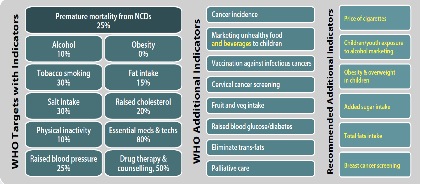
This week the member states of the World Health Organization are meeting in Geneva to agree on a Global Monitoring Framework  for noncommunicable diseases (NCDs).   Meeting participants discussed indicators and targets that could be used to assess progress towards achieving the goal of reducing preventable deaths from NCDs by 25 percent by 2025.  Also participating in the meeting was the NCD Alliance, a network of more than 2,000 civil society organizations from more than 170 countries.  The Global Action Plan and the Global Monitoring Framework on NCDs are a result of the United Nations High-Level Meeting of the General Assembly on NCDs held in New York City in September 2011. 


The discussions at the meeting in Geneva focused on what to measure.  As shown below, WHO has set 2025 targets as shown in the column on the left and then proposed additional indicators as shown in the middle column.  The NCD Alliance has recommended some additional indicators, shown in the column on the right.


These targets and indicators mark an important step forward in controlling NCDs. As Cary Adams, the Chair of the NCD Alliance noted in Geneva , the “commitment to measuring our progress and setting realistic and achievable goals, supported by the investment required, will…make a real difference to those of us who have or will develop NCDs in our lifetime. “


But monitoring changes in health status and health behavior related to NCDs and government NCD prevention policies may not be enough to achieve the stated goals.  As several experts have acknowledged, the business and political practices of the alcohol, tobacco and food industries play a critical role in the development of NCDs.[i][ii][iii] Without changes in these practices, it will be difficult to reduce premature deaths.  To encourage the discussion of indicators and targets for such monitoring, I suggest some provocative goals for the monitoring of corporate practices.


  1. Reduce expenditures on marketing alcohol, tobacco and unhealthy foods by the top 10(or 20 or 50) global producers of each of these products by a fixed percentage each year. The alcohol, tobacco and food industries are heavily concentrated with the top firms controlling a significant portion of market share.[iv][v][vi]  Since research evidence shows that more marketing leads to more consumption of these products associated with NCDs,[vii] less marketing could reduce exposure to this negative influence.
  2. Reduce corporate expenditures on lobbying and campaigns contributions for the top 10(or 20 or 50) global producers of alcohol, tobacco and unhealthy food by a fixed percentage each year. Tobacco, alcohol and food corporations have used their political and economic clout to undermine public health protections and to create an environment that allows them to promote behaviors and lifestyles associated with NCDs. [viii][ix][x] Restricting their ability to externalize the costs of the NCDs associated with their products and to thwart the democratic principles of one person one vote could help to prevent premature deaths, reduce government expenditures on health care and restore more democratic processes.
  3. Require tobacco, alcohol and food companies to commission an independent health impact assessment of any new product or practice and to make the assessment publicly available.


Each year, these companies introduce thousands of new products and practices. Often, however,  the adverse health impact is not recognized for years.  Requiring companies to hire independent researchers to complete health impact assessments according to uniform standards prior to exposing the population to such practices or products and to make such reports public could discourage companies from releasing into the market inadequately tested products. 


How could such targets be monitored?  The World Health Organization and other global bodies, the NCD Alliance and its network of NGO partners, national governments and other bodies could each play a role in setting targets and monitoring this indicator.  Global organizations could limit participation in international forums to those organizations who achieved targets.  Institutional investors could invest in companies that met targets and disinvest from those that did not.   National governments could favor companies meeting targets for procurement contracts and penalize those that failed to meet the targets.  They could also offer subsidies or tax breaks to companies that achieved targets. Some nations may choose to make these guidelines mandatory, especially for practices implicitly or explicitly designed to increase consumption of unhealthy products by children and young people.  


In the current political climate, these proposals will of course elicit intense opposition from corporations and their allies.  But 50 years ago the current measures in place to control tobacco use would have been unthinkable.  Effective public health officials need to compromise but before they compromise, they have to be able to articulate public health goals that are based on the evidence and have the potential to fulfill the mandate to protect population health.    Unless public health professionals,  researchers and advocates begin discussing now how to take action to end the corporate practices that contribute to the preventable illnesses and premature mortality  that  NCDs impose, 50 years from now we’ll still be lamenting the steady increase in the health burden and economic costs imposed by NCDs. 


[i] Beaglehole R, Bonita R, Horton R, et al., and the NCD Alliance. Priority actions for the non-communicable disease crisis. Lancet. 2011;377(9775):1438-47.

[ii] Magnusson RS. Rethinking global health challenges: towards a ‘global compact’ for reducing the burden of chronic disease. Public Health. 2009;123(3):265-74.

[iii] Lien G, DeLand K. Translating the WHO Framework Convention on Tobacco Control (FCTC): can we use tobacco control as a model for other non-communicable disease control? Public Health;125(12):847-53.

[iv] Jernigan DH. The global alcohol industry: an overview. Addiction. 2009 Feb;104 Suppl 1:6-12.

[v]    Eriksen M, Mackay J, Ross H.  Chapter 18 Tobacco Companies in The Tobacco Atlas 4th Edition  pp. 56-57

[vi] Stuckler D, Nestle M. Big food, food systems, and global health. PLoS Med.2012;9(6):e1001242.

[vii] Stuckler D, McKee M, Ebrahim S, Basu S (2012) Manufacturing Epidemics: The Role of Global Producers in Increased Consumption of Unhealthy Commodities Including Processed Foods, Alcohol, and Tobacco. PLoS Med 9(6):e1001235.

[viii] Brownell KD (2012) Thinking Forward: The Quicksand of Appeasing the Food Industry. PLoS Med 9(7):e1001254.

[ix] Freudenberg N. The manufacture of lifestyle: the role of corporations in unhealthy living. J Public Health Policy. 2012 May;33(2):244-56.

[x] Gilmore AB, Savell E, Collin J. Public health, corporations and the new responsibility deal: promoting partnerships with vectors of disease? J PublicHealth (Oxf). 2011;33(1):2-4.