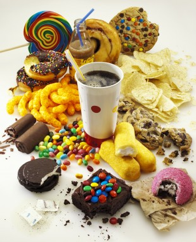
Obesity Prevalence and Costs Rise: House of Representatives and Supreme Court Hamstring Fight Against Obesity

A new report to be published in the American Journal of Preventive Medicine estimates a 33 percent increase in obesity prevalence and a 130 percent increase in severe obesity prevalence over the next two decades. By 2030, according to this forecast, 42 percent of Americans will be obese and 11 percent severely obese. The authors conclude that “if these forecasts prove accurate this will further hinder efforts for healthcare cost containment.” The authors also conclude that if obesity rates stayed at the 2010 levels, the combined savings in medical expenditures by 2030 would be $549.5 billion.

Another new report published in the Journal of Health Care Economics estimated that the total cost of health care associated with U.S. obesity is now $190.2 billion a year, or 20.6 percent of total U.S. health spending – twice as much as previously reported.

Last month, the US House of Representatives voted to eliminate the Prevention and Public Health Fund in order to pay for legislation dealing with student loans. Although the measure is not expected to pass the Senate and President Obama has vowed to veto it, by this vote the House proposed to eliminate one of the few streams of funding to support preventive measures to reduce obesity and other health problems that contribute to diabetes, heart disease and cancer.

Last week Public Citizen and the National Association of Consumer Advocates released a report called Justice Denied One Year Later. The report notes that in the one year since the U.S. Supreme Court’s decision in AT&T Mobility v. Concepcion, consumers have regularly been blocked from pursuing class-action cases. In its Concepcion decision, the court vastly expanded the reach of arbitration by ruling that corporations could block the consumers they force into arbitration from pursuing cases as a class.

According to the report:

Since Concepcion, judges have cited the case in decisions that stopped at least 76 potential class-action lawsuits from going forward. Several judges have expressed frustration that the decision has forced them to stop consumer actions that are best suited to proceed as class actions. Class-action lawsuits historically have provided a means to combat illegal payday lending practices, contest poor business practices and confront discriminatory auto lending. But Concepcion has left many consumers without a means to pursue redress.

In the case of tobacco, public health experts agree that class action lawsuits played a vital role in strengthening public health protection against a tobacco industry determined to make profits even at the expense of their customers’ health.

Whatever the intentions, by seeking to de-fund one of the few federal funding streams for prevention of obesity and other diet-related diseases and by denying consumers a powerful tool to change food industry practices that have been shown to contribute to obesity, the House of Representatives and the Supreme Court have voted to endorse the status quo of rising obesity rates.


Image Credits:
1. allgoodprovisions.com

Jump in Sales of Used SUVs

The New York Times reports that retail prices for five-year-old full-size S.U.V.’s are 23 percent higher than a year ago, according to Edmunds.com, an automotive information Web site. That is more than double the average price increase of 11 percent for all five-year-old vehicles. Prices for three-year-old S.U.V.’s are up 6 percent, triple the 2 percent average increase for all vehicles that age.  However, auto safety experts fear that used SUVs, driven by younger, less skilled drivers and less well maintained than new vehicles may cause even higher rates of driver and pedestrian injuries and fatalities than new SUVs, illustrating the long shadow of an environmentally destructive product.

Stop “Drink Responsibly” Charade, says Alcohol Justice

Market Watch reports that Alcohol Justice, the U.S. based alcohol industry watchdog, released an in-depth report debunking Big Alcohol’s cynical “Drink Responsibly” messages. “Alcohol producers and marketers are more interested in their public relations than public health,” said Sarah Mart, MPH, director of research at Alcohol Justice and co-author of the new report, How Big Alcohol Abuses “Drink Responsibly” to Market Its Products. “So it’s not surprising that they hide behind a vague, ineffective slogan that does nothing to reduce the annual catastrophe of harm caused by their products.”

New Report on Policies to Slow Down Fast Food


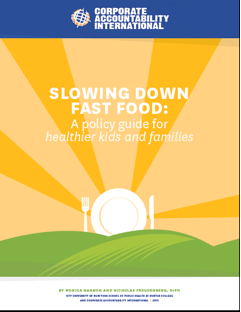
On the heels of a new study in the Journal of Health Economics, which finds that the U.S. spends more than $190 billion a year on medical costs associated with obesity, Corporate Accountability International and Dr. Nicholas Freudenberg and Monica Gagnon of The City University of New York have released a report that will serve as a tool to address the rising epidemic of diet-related disease.

The report, Slowing Down Fast Food: A policy guide for healthier kids and families, documents ways in which city and county policymakers can address the toll that diet-related disease is taking on their municipalities and on their communities’ health.

It offers specific solutions to curb a primary contributor to the problem – the overconsumption of fast food and the ubiquitous marketing of fast food to children.

“Parents and policymakers have long felt at a disadvantage to counter the ubiquity of junk food and its marketing,” said Dr. Freudenberg. “This guide will empower families and communities to create healthier food environments for current and future generations.” Slowing Down Fast Food focuses on four local policy approaches: school policy, “healthy” zoning, curbing kid-focused marketing, and redirecting subsidies to healthier businesses.

As case studies in the report demonstrate, dedicated grassroots initiatives can overcome the food industry’s staunch opposition and build the political will sufficient for the passage of strong public health policies. For example, in San Francisco, the groundbreaking Healthy Meals Incentive Ordinance set basic nutritional standards for kids’ meals that are accompanied by toy giveaways. It was the power of grassroots initiatives involving parents, health professionals, and community leaders that helped secure the passage of this ordinance.

“What we can take from the city’s action is that all cities and towns could pursue and institute like-minded policies,” said San Francisco City Supervisor Eric Mar, the sponsor of the measure. “While no single community or organization can match the political and economic might of the fast food industry, we can make change on the community level that effectively challenges the fast food industry’s negative impact on public health.”

Such policies have positive and direct effects, but also have helped provoke critical changes across the food industry at large. While McDonald’s and its trade association attempted to block the ordinance, ultimately the burger giant and its competitors altered their practices internationally. For example, shortly after the San Francisco ordinance passed, Jack in the Box, the nation’s fifth largest burger chain, pulled the toy giveaways from its kids’ meals.

National media coverage of the San Francisco ordinance also helped foster public discourse and a deeper understanding of the harmful impact of marketing fast food to children. A growing number of studies have found that ending junk food marketing directed at kids could spare the health of millions of children. In June, the American Academy of Pediatrics even urged a ban on junk food advertising to children as part of a new research review published in the Pediatrics journal.

The report also identifies the obstacles to the passage of policies addressing fast food, namely industry opposition, interference, cooption and avoidance of regulation. It documents how fast food corporations use their political and financial clout to advance their interests, even when their products or practices jeopardize health. While this type of pervasive corporate interference has translated into inaction in Congress, local policy solutions have proven an effective means of countering special interests and protecting public health.

“Corporate influence may be drowning out the will of the people in our nation’s capital right now, but it cannot be allowed to remain this way,” said Kelle Louaillier, executive director of Corporate Accountability International. “Change needs to and can start at the local level, and the policies in this report are a critical place to start.”

The report and its companion Action Guide offer specific, practical guidance for putting policy concepts into motion, offering additional resources from a wide range of organizations engaged in protecting our health from the abuses of fast food corporations.

Individuals and policymakers can access and download the report at Slowing Down Fast Food: A policy guide for healthier kids and families.

Corporate Accountability International (formerly Infact) is a membership organization that, for the last 35 years, has successfully advanced campaigns protecting health, the environment and human rights. Value [the] Meal is Corporate Accountability International’s campaign dedicated to reversing the global epidemic of diet-related disease by challenging the fast food industry to curb a range of its practices.

Food Industry Continues to Thwart U.S. Public Health Policy

“After aggressive lobbying, Congress declared pizza a vegetable to protect it from a nutritional overhaul of the school lunch program this year. The White House kept silent last year as Congress killed a plan by four federal agencies to reduce sugar, salt and fat in food marketed to children.” In a special investigative report on food industry lobbying, Duff Wilson and Janet Roberts write for Reuters that “during the past two years, each of the 24 states and five cities that considered “soda taxes” to discourage consumption of sugary drinks has seen the efforts dropped or defeated. At every level of government, the food and beverage industries won fight after fight during the last decade. They have never lost a significant political battle in the United States despite mounting scientific evidence of the role of unhealthy food and children’s marketing in obesity.”

Cigarette Companies and Their Underhanded Tactics

“As a former cigarette company employee, I have no sympathy for their attempts to challenge the Federal Government’s plain packaging” writes David Donovan, a former tobacco company employee, in an op ed in Independent Australia in response to the Australian tobacco industry’s efforts to reverse new packaging rules. Cigarette companies have bribed and subverted the political process for too long. I know this, because for three years in the mid-1990s, I worked for a cigarette company in Brisbane, where I saw this company blatantly try to ensure employees, including myself, were hooked on nicotine, as well as their bribery of politicians and public officials.”